The State of Voice-to-Text 2026: Adoption, Speed & Accuracy Benchmark
For two decades, voice-to-text was the technology that was always five years away. In 2026 it quietly arrived. The tools got fast enough, accurate enough, and smart enough that talking became a real input method — not a novelty, not an accessibility workaround, but the way a growing share of professionals now write.
This report compiles the most credible recent data on voice-to-text — also called AI dictation or voice typing — and analyzes what it means for the people and teams deciding whether to put down the keyboard. We focus on four questions: How many people are actually using voice-to-text? How much faster is it really? How accurate has it become? And how big is the market behind it?
Then we map how the category has stratified and finish with what the data means for buyers in 2026. This is a research report, not a buyer's guide — if you want the hands-on head-to-head of specific products, with latency, languages, free tiers and pricing, that lives in our best dictation software comparison.
The State of Voice-to-Text 2026 — Key Findings
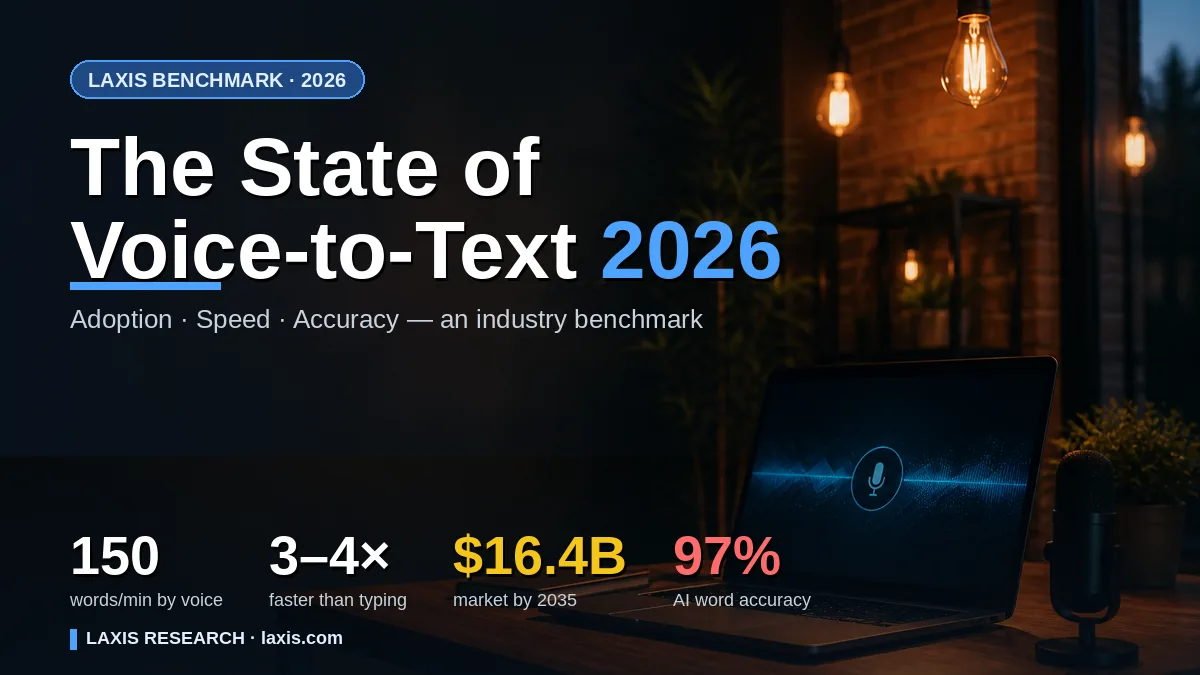
- 150 WPM — Average speaking speed, against just 40–60 WPM for typing
- 3–4× — Raw speed advantage of voice-to-text over typing (~2.5× after editing)
- 97.9% — Word-accuracy benchmark for the Whisper engine that powers most tools
- $16.4B — Projected AI speech-to-text market by 2035, up from $3.3B in 2025
- ~50% — Of U.S. workers now use AI on the job, accelerating voice adoption
- 270 — Fortune 500 companies using a single leading voice keyboard (Wispr Flow)
- 70% — 12-month retention for that tool — the stickiness the Dragon era never reached
- ~2M — U.S. workers affected by repetitive strain injury each year, pushing many hands-free
1. Adoption: Voice-to-Text Went Mainstream
The clearest signal of 2026 isn't a single product launch — it's that talking to a computer stopped feeling strange. Roughly half of all U.S. workers now report using AI on the job, according to an April 2026 Gallup workplace survey, and a fast-growing slice of that usage is voice input rather than typing into a chat box.
The behavioral groundwork was already there. There are about 8.4 billion active voice assistants worldwide, more than half of smartphone users run a voice search on any given day, and around 32% of consumers now search by voice rather than typing daily. People were already comfortable talking to their devices. What changed is that the output finally became good enough to use for real work — emails, documents, Slack messages, code comments — not just "set a timer."
Sources: Gallup Workplace Survey (April 2026); DemandSage & Yaguara Voice Search Statistics 2026; SQ Magazine Voice Assistant Usage 2026.
Adoption is not evenly spread. Solo professionals and developers are leading the shift to voice-first workflows, with sales, recruiting, and customer-success teams close behind as headset-based work becomes normal. The common thread is volume of writing: the more of your day is spent documenting, messaging, or drafting, the bigger the payoff from voice-to-text — which is exactly why doctors, lawyers, and knowledge workers were the earliest serious adopters.
The office got louder. One genuinely new 2026 side effect: open-plan offices report more people muttering at their screens. The etiquette of dictating in shared space — whisper modes, headsets, booking a room to talk — is becoming a real workplace question for the first time.
2. The Speed Case: Why Talking Beats Typing
Most people considering voice-to-text want one number first: how much time does it actually save? The honest answer has a range, and the range matters.
The headline figures are real. The average person types at 40 to 60 words per minute but speaks at 130 to 150 — roughly a 3x gap, a finding Stanford researchers confirmed years ago. A 2025 multi-country clinical study went further, measuring documentation speed across 72 accents: a median of 93 WPM by voice against just 21.5 WPM by keyboard, a 4.3x increase.
But here's the part the product demos leave out. That same study also measured an error-adjusted speed — factoring in the time spent fixing what the tool got wrong — and the advantage dropped to about 55 WPM, or 2.5x. Still a substantial win. Just not the number on the landing page. The gap between "4x faster" and "2.5x faster in practice" comes down entirely to how much cleanup you do, which is why the quality of a tool's AI editing layer matters more than its raw transcription speed.
Sources: Stanford voice-input study; multi-country ASR documentation study (medRxiv, 2025), n across 72 accents; NCVS speaking-rate data.
Quick tip: When you trial a voice-to-text app, don't judge it on one clean paragraph. Dictate a messy real task — an email with a name and a date, a Slack reply, a list — and count the edits you make afterward. That edit count, not the advertised WPM, is your true speed.
The health dividend nobody markets
Speed isn't the only reason people switch. Nearly 2 million U.S. workers a year are affected by repetitive strain injuries like carpal tunnel and tendinitis, and RSI-related costs run into the tens of billions annually in compensation and lost working days. Voice-to-text lets the hands rest while the work continues — which is why, for a meaningful group of users, dictation isn't a productivity hack at all. It's how they keep working without pain.
3. Accuracy in 2026: Better Than You Think — Not Equal for Everyone
Accuracy is where voice-to-text is strongest, and where it's least honest. The good news: most leading tools clear 95% word accuracy in decent conditions, and OpenAI's Whisper engine — which sits under several of these apps — has been benchmarked at 97.9% by MLCommons. For single-speaker audio in a quiet room, modern voice typing is genuinely excellent.
The asterisks are real, though. Accuracy falls off with background noise, overlapping speakers, and unfamiliar vocabulary. And research has repeatedly found that speech recognition performs measurably worse for non-white speakers — a bias that hasn't been solved no matter how high the average benchmark climbs. If your accent or your jargon sits outside the training distribution, your experience won't match the headline number. This varies more between people than between products, so it's worth testing personally before you commit.
Sources: MLCommons speech benchmark; published research on demographic disparities in ASR word-error rates.
Quick tip: A decent USB or headset microphone improves real-world accuracy more than switching apps does. Laptop mics pick up keyboard clatter and room echo that no model fully cleans up — fix the input before you blame the software.
4. The Market: A $16 Billion Category in the Making
The money tells a clean story. The AI speech-to-text tool market was worth about $3.3 billion in 2025, is on track to clear $3.87 billion in 2026, and is projected to reach $16.4 billion by 2035 — a compound growth rate north of 17% a year. That's not a fad curve; it's infrastructure being built.
The clearest single signal came in May 2026, when Wispr Flow — probably the most recognizable voice keyboard in the space — reportedly hit a $2 billion valuation. By then it counted 270 Fortune 500 companies among its users, including Nvidia and Amazon, and claimed 2.5 million downloads between late 2025 and early 2026. The metric that matters most to anyone who lived through the Dragon NaturallySpeaking era, though, is retention: a reported 70% of users were still active twelve months in. People weren't just trying voice-to-text. They were keeping it.
Sources: Precedence Research AI Speech-to-Text Tool Market; reported Wispr Flow funding and usage figures (May 2026).
The platform shadow: In May 2026, Google added a Gemini-powered dictation feature ("Rambler") to Gboard. When the default keyboard on billions of phones gets smart voice typing built in, the standalone tools have to justify why they're better — which is accelerating the move from plain dictation toward AI agents (see §6).
5. How the Category Stratified
The most useful structural finding of 2026 is that transcription quality stopped being a differentiator. Every serious tool now clears the mid-nineties on word accuracy in good conditions, because they are largely built on the same generation of speech models. Competition moved somewhere else.
What the field actually splits on now is four axes, and a tool's position on them predicts its price far better than its accuracy does:
Where the processing happens. Cloud tools can run a large language model over the raw transcript to produce finished prose; on-device tools run a smaller model locally and trade some polish and startup time for the guarantee that audio never leaves the machine. This is the single sharpest line in the category, and it is a compliance decision before it is a preference.
How many surfaces the tool covers. Coverage ranges from Mac-only to the full spread of Windows, macOS, iOS, Android and the browser. Because the value of dictation compounds with habit, and habit breaks when you switch devices, breadth turns out to matter more to twelve-month retention than any per-session speed advantage.
How specialised the vocabulary is. General engines handle common English well and proper nouns badly. A minority of tools train or tune for a domain — code identifiers, clinical terminology — and win decisively inside it while giving up language breadth to do so.
How far past dictation the product reaches. This is the newest axis and the one carrying the most pricing power. Some tools stop at turning speech into text. Others attach that input to meeting capture, retrieval over your own past conversations, and agents that act on what you said. Section 6 covers why that expansion is where the category's margin is migrating.
Read those four axes together and the pricing spread in the market — roughly $7 to $30 a month — makes sense in a way an accuracy table never explains. A tool priced at the bottom is usually on-device and narrow; one at the top is usually cloud-based and doing something after the transcription. For the current head-to-head on where each named product sits across all four axes, with tested latency and 2026 prices, see our dictation software comparison.
5b. "Talk to Text": The Same Thing By Another Name
A note on vocabulary, because it affects how people find these tools at all. Talk to text is the phrase a large share of users type into a search box, and it means exactly what voice-to-text means: you speak, and written text appears. There is no technical distinction between talk to text, voice-to-text, voice typing, speech-to-text and dictation — they are five labels for one capability, and which one you use is mostly a function of which platform taught it to you.
The labels came from different places. Google shipped "Voice typing" in Docs and on Android. Microsoft uses "voice typing" in Windows. Apple has always called its version "Dictation." "Speech-to-text" is the engineering term for the underlying conversion. And "talk to text" is what the phrase became in ordinary speech, particularly on mobile, where the action really is just talking to a phone.
The practical consequence is that people searching for "talk to text" and people searching for "dictation software" are looking for the same products but often land in different corners of the internet, one aimed at casual phone users and the other at professional buyers. If you arrived here from the casual end: the built-in feature on your phone is free and already switched on, and the paid tools in this report differ from it mainly in that they edit what you said rather than transcribing it literally. Our guide to AI keyboards covers how to turn on the free version on every operating system.
6. Beyond Dictation: From Voice-to-Text to Voice Agents
Here's the shift that will define the next year of this category: the most interesting tools have stopped thinking of themselves as keyboards. A voice keyboard turns speech into text. An agent acts on it.
That's the line Laxis is built across. The voice-to-text itself is fast — sub-800ms latency, 100+ languages with auto-detection so seamless you can start a sentence in English and finish it in Spanish without touching a setting. But press the hotkey and ask a question instead of dictating, and it answers, pasting an AI-generated reply directly into whatever app you're in. Because that agent draws on a personal knowledge base built from your own transcribed meetings, it can do things a dictation tool structurally can't: pull a decision from last week's call into the email you're writing, or turn a conversation into a follow-up and a task list on demand.
That bundling is the structural point, and it's why the pricing in this tier looks the way it does: a subscription that covers dictation, an agent, and meeting capture together competes on total workflow rather than on cost per transcribed word. The honest caveat is that this capability depends on cloud processing — Laxis is cloud-only, so where on-device is a hard requirement the on-device tools remain the answer. For everyone else, the buying question has shifted from "which app types my words fastest" to "which one does the most with them." The dictation software comparison has the current numbers on both sides of that trade.
Translation for buyers: plain voice-to-text is becoming a commodity — even Gboard does it now. The durable value is in what surrounds the dictation: context, memory, and the ability to act on what you said. That's where the category's premium is migrating.
7. What This Means for Teams & Buyers in 2026
Strip away the feature lists and the decision comes down to three questions about how you work, in this order. Can your audio leave the machine? If the answer is no, on-device processing is the only specification that matters and it narrows the field to a handful of tools before you compare anything else. How many devices does your writing happen on? Retention data says this is the criterion people underweight most and regret most — a tool that covers only half your day builds only half a habit. Does your work generate conversations you need to act on later? If your day is a stream of meetings, emails and follow-ups, a tool that only types is solving the smaller half of the problem — which is the case for an all-in-one like Laxis.
Answer those three and you'll have narrowed the market to two or three candidates. Our dictation software comparison takes it from there with tested latency, language counts, free-tier limits and current pricing for each.
If you take one thing from this report, take this: voice-to-text has crossed the threshold of trust. The retention numbers say the people who adopt it don't go back. The open question for the next eighteen months isn't whether it works — that's settled — but how much it will do once it has your attention. Whatever you trial, give it a real week, not a clean demo. The only test that counts is whether you reach for your keyboard less at the end of it.
Try voice-to-text that does more than type. Dictation, an AI agent, and a meeting assistant in one app — with a free tier worth ~40,000 words a month. Get Started with Laxis
Frequently Asked Questions
What is voice-to-text and how does it work in 2026?
Voice-to-text — also called AI dictation or voice typing — converts spoken words into written text. In 2026 the leading tools go beyond raw transcription: a speech engine like OpenAI's Whisper (benchmarked at 97.9% word accuracy) handles the transcription, then a large language model removes filler words, fixes punctuation and grammar, and adapts tone to the app you're writing in. The result reads like edited writing, not a transcript.
Is voice-to-text actually faster than typing?
Yes. Most people type at 40–60 WPM but speak at 130–150, making voice-to-text roughly 3x faster. A 2025 study across 72 accents found 93 WPM by voice versus 21.5 WPM typing (4.3x); after editing time, the realistic advantage is about 2.5x. Low latency is what makes it feel fast in practice.
How accurate is voice-to-text in 2026?
Leading tools clear 95%+ word accuracy in good conditions, with Whisper benchmarked at 97.9%. Accuracy drops with noise, crosstalk, and heavy accents, and research shows speech recognition still performs worse for non-white speakers — so it's worth testing with your own voice.
What is talk to text?
Talk to text is another name for voice-to-text: you speak, and software converts your speech into written text. It is the same capability that platforms variously label voice typing (Google, Microsoft), Dictation (Apple), or speech-to-text (the engineering term). There is no technical difference between them — the label depends on which platform introduced you to the feature. Free versions are built into every major phone and computer; paid AI tools differ mainly in that they edit what you said rather than transcribing it word for word.
How is the voice-to-text market segmented in 2026?
Transcription accuracy is no longer the differentiator — serious tools all clear the mid-nineties in good conditions because they share a generation of underlying speech models. The market now segments on four axes: whether processing runs on-device or in the cloud, how many operating systems a tool covers, how specialised its vocabulary is, and how far past plain dictation the product reaches into meeting capture and agents. Those four explain the $7-to-$30 monthly pricing spread far better than accuracy does. For where individual products land, see our dictation software comparison.
Why are workers switching from typing to voice-to-text?
Speed (3–4x faster), AI cleanup (output now reads like finished writing), and health — nearly 2 million U.S. workers a year are affected by repetitive strain injuries from typing. With roughly half of U.S. workers now using AI on the job, continuous voice input is becoming a default for solo professionals, developers, and sales and customer-success teams.
Is voice-to-text private and secure?
It varies. Cloud tools (Laxis, Wispr Flow, Typeless) send audio to servers; Superwhisper runs entirely on-device on Apple Silicon. For confidential work, on-device is safest; otherwise check the vendor's data-retention policy.
Methodology & Sources
This report aggregates and analyzes recent (2025–2026) data on voice-to-text, AI dictation, and speech recognition from Gallup, MLCommons, Precedence Research, a 2025 multi-country ASR documentation study (medRxiv), DemandSage, Yaguara and SQ Magazine voice-search statistics, published RSI and ergonomics data, and reported vendor figures for Wispr Flow, Superwhisper, Typeless, Aqua Voice, and Laxis. Where source estimates diverge, we report ranges and indicate methodology. Pricing reflects annual-plan rates current as of June 2026 and may change. This report is intended as a citation-friendly reference; sources are named with each figure to support journalist and analyst use.