Prise de notes de réunion et IA en 2026 : adoption, ROI et repères marché
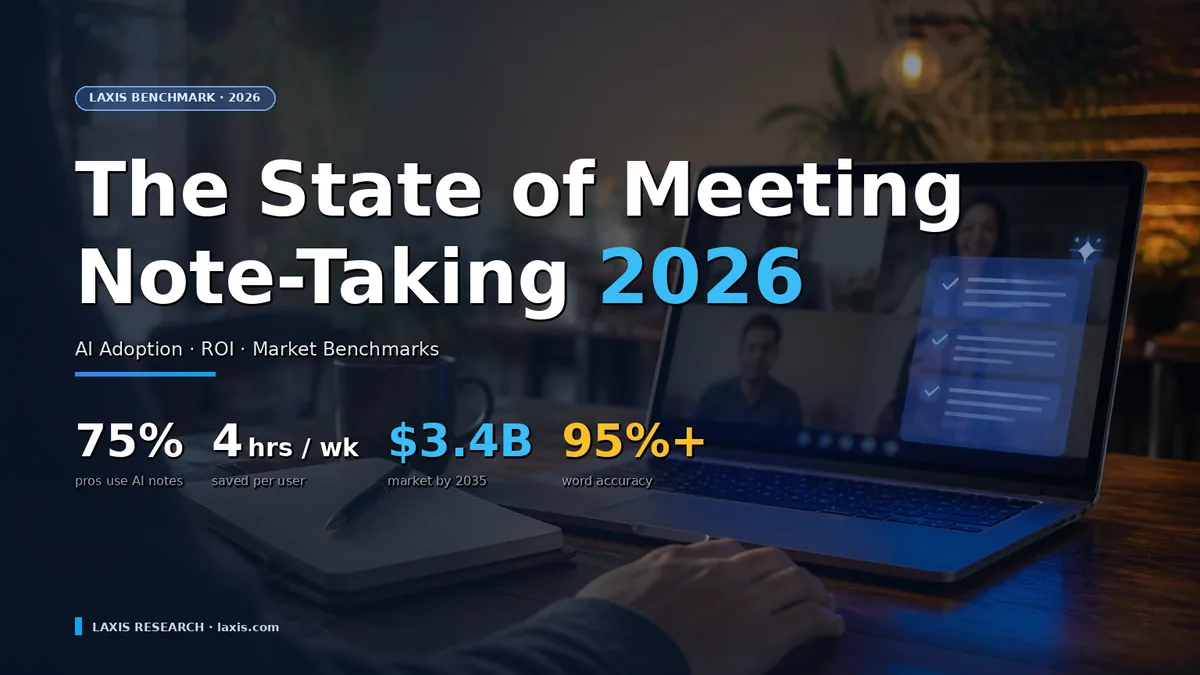
The State of Meeting Note-Taking 2026 — Key Findings
- 75% — Of professionals now use an AI note-taker in their work meetings
- 67% — Of Fortune 500 companies have deployed AI note-takers somewhere in the org
- 4 hrs / wk — Time saved per user with AI meeting assistance (62% of users report this)
- $3.48B — Projected AI note-taking market size by 2035 (18.75% CAGR)
- 95%+ — Transcription accuracy on clean audio with leading 2026 models
- 73% — Of businesses cite privacy as the #1 barrier to broader AI note-taker adoption
- 85–95% — Action-item completion rate with AI-generated notes (up from 50–60%)
- 146 hrs — Hours per year the average professional spends reconstructing meeting context — without AI
If you joined a professional meeting in 2026, there's a 3-in-4 chance someone in the room was running an AI note-taker — and increasingly, the AI itself was in the room as a participant. The shift from manual note-taking to AI-generated summaries has been the fastest workflow change in modern white-collar work, faster than the move from desktop to laptop, faster than the shift to Slack, faster than the shift to video.
This report compiles the most credible recent data on AI meeting note-takers and analyzes what it means for teams, sales orgs, and IT/security leaders making 2026 buying decisions. We focus on four questions: How fast has adoption moved? What's the actual measurable ROI? What's gotten genuinely better — and what hasn't? And what's the privacy and compliance picture an enterprise needs to plan around?
1. Adoption: From Early-Adopter Tool to Default Infrastructure
The defining number of 2026 is 75%. Three out of four professionals now use an AI note-taker in their work meetings. This figure has roughly doubled since 2023 and the pace has not slowed — adoption is now layering down from white-collar knowledge workers into customer success, healthcare, legal, education, and field sales.
67% of Fortune 500 companies have deployed AI note-takers somewhere in the organization, though "deployed somewhere" hides a huge amount of variation in how broad and policy-governed those deployments are. The IBM Global AI Adoption Index puts the figure at 45% for companies that use AI for internal knowledge management — search, summaries, documentation, and meeting notes considered together — making meeting capture the single largest entry point for enterprise AI in 2026.
The enterprise gap: SMBs and mid-market companies have raced past the F500 on AI note-taker adoption. The bottleneck at the top isn't tooling — it's procurement, legal review, and IT shadow-app risk. Sources: meetingstack adoption data; Sonix transcription adoption survey; Fellow.ai State of AI Note-takers.
The adoption curve has an interesting shape: highest at the small-business end (78–81%), dips at mid-market (61% for 1,001–5,000 employees), and dips further at large enterprise (43% for 5,000+ employees). This is not because enterprises don't want AI notes — they do. The bottleneck is governance: SOC 2 review, data-residency requirements, model-training carve-outs, and the slow process of standardizing on one or two approved vendors after months of "every team uses a different note-taker" sprawl.
The shadow IT pattern: In enterprise environments, AI note-taker adoption almost always starts as shadow IT — individual employees inviting third-party AI bots into calls — and then gets formalized 18 months later, typically after a CISO discovers how widespread the practice has become. 84% of users change their behavior or withhold information when they notice an AI bot in a call, which is why enterprise rollouts increasingly favor bot-free capture options.
Market trajectory
The AI note-taking market was sized at $623.5M in 2025. By 2026 it crosses $740M, and the consensus forecast carries it to roughly $3.48 billion by 2035 — an 18.75% compound annual growth rate. The meeting-transcription sub-segment is growing faster: 25.6% CAGR through 2034, driven by vertical-specific products in healthcare, legal, and sales.
2. The ROI Picture: What Users Actually Save
The most cited ROI figure for 2026 is the cleanest one: 62% of users save 4 hours per week with AI meeting assistance — about a month of productive time reclaimed per user, per year. The savings stack on three layers:
- Note-taking time itself. The 25–40 minutes a meeting attendee used to spend after a 1-hour call writing recap notes, formatting them, and distributing them.
- Recall and context reconstruction. The 146 hours per year the average professional spends trying to remember what was said in a prior meeting — and re-asking colleagues for context that AI search can return instantly.
- Follow-through. The 30–50% of action items that simply never got done because no one remembered them after the fact.
The ROI multiplier is integration, not transcription. Once meeting outputs flow automatically into Salesforce, HubSpot, your project tracker, or your support tool, the time savings compound. Sales teams with full CRM auto-sync report 8–12 hours saved per week per rep — a 4–10x ROI on the tooling spend.
For sales orgs specifically, the data is striking. Conversation intelligence is now the fastest-growing AI category in 2026, with 27.7% of field teams already using it. The driver is administrative load: SDRs and AEs typically spend around 70% of their time on non-selling work, and automated CRM-from-meeting workflows return 15–20% of selling time directly to the rep.
The reported ROI on full AI meeting assistant deployment in sales lands at 4–10x, with $25,000+ in annual ROI per employee reported by top implementations. The largest single contributor isn't transcription accuracy or summary quality — it's not having to manually log the call after.
3. Quality: What "Good" Means in 2026
Three years ago, "AI meeting notes" meant a raw, often-garbled transcript. In 2026, the bar has moved.
Leading models hit 95%+ word accuracy on clean audio and 85–90% on challenging multi-speaker environments with crosstalk, accents, and domain jargon. Speaker diarization (who said what) is now reliable for up to 8 distinct speakers in most products. But the more important quality shift isn't accuracy — it's structure.
The 2026 standard output is no longer a transcript. It's a structured summary that includes:
- A 3–7 sentence executive summary tuned to the meeting type
- Decisions, distinguished from discussion
- Action items with named owners and dates
- Open questions that didn't get resolved
- Topical sections (intro, discussion, next steps) with anchor links into the transcript
- For sales meetings: BANT/MEDDIC fields, objections, competitors mentioned, and CRM-ready field values
| Capability | 2022 baseline | 2026 standard |
|---|---|---|
| Word accuracy (clean audio) | ~85% | 95–97% |
| Speaker identification (up to 8 voices) | Best-effort, frequent errors | Reliable, with name attribution |
| Action item extraction | Manual | Automatic, with owner + due date |
| Cross-meeting search | Single-meeting transcript only | Searchable across entire org history |
| CRM & tool sync | Copy-paste workflow | Auto-sync to Salesforce / HubSpot / etc. |
| Real-time use | Post-meeting only | Live coaching, real-time summary, in-meeting search |
The functional gap between an AI note-taker and a junior team member taking notes has closed. The remaining quality differentiators in 2026 are: (a) how well the summary reflects the team's terminology and templates, (b) how well the tool plays with adjacent systems (CRM, Notion, Linear, Slack), and (c) how well it handles multilingual meetings — which is the single biggest 2026 demand from global teams.
4. Privacy, Compliance, and the Enterprise Reality Check
If the first half of this decade was about proving that AI note-takers work, the second half is about proving they're safe to deploy. 73% of businesses now cite privacy concerns as the primary barrier to broader adoption. Among professionals who do not yet use an AI note-taker, 50% cite privacy and security as the main reason.
The risk has three layers, only one of which gets discussed publicly.
a) The audio file
The least worrisome layer. Audio files are routinely encrypted at rest and in transit by leading vendors. Where they live (which cloud region) and how long they're retained (typically configurable 30–90 days) is well-understood and easily auditable.
b) The transcript
More sensitive. Transcripts contain the full content of conversations — pricing, customer PII, internal strategy, legal exposure, HR sensitivities. Enterprise-grade products allow per-meeting redaction, retention controls, and role-based access. The maturity bar here has risen quickly, but coverage is uneven.
c) The LLM prompt payload
The most under-appreciated risk. When a meeting is summarized, the entire transcript is typically sent via API to an LLM provider. On default commercial API tiers, that data can be retained for 30 days for abuse monitoring — and historically, some providers used it for model training without explicit opt-out. For SOC 2 Type II and HIPAA-covered workloads, this is a deal-breaker without explicit "no training" contractual language and zero-retention API tier configuration.
The 2026 enterprise checklist for AI note-taker procurement: SOC 2 Type II, GDPR & CCPA-compliant data subject rights including right-to-deletion, explicit contractual language that data is not used for model training, configurable retention windows, regional data residency, and a "bot-free" or zero-footprint capture option for sensitive meetings. Any vendor without all six is no longer competitive at enterprise scale.
Regulatory pressure is also climbing. In the U.S., several state-level all-party-consent recording laws have produced active litigation against the assumption that joining a meeting with an AI bot implies consent. In the EU, GDPR concerns about automated processing of speech, especially with cross-border data flows, are reshaping how international enterprises configure these tools. The legal posture in 2026 is clear: notify participants and offer them an opt-out, every meeting.
5. The 2026 Competitive Landscape
The market has stratified into three distinct segments, each with its own buyer and its own product logic.
The platform-bundled summarizers
Zoom AI Companion and Microsoft Teams Copilot are the largest single forces in the market by raw user count. Zoom AI Companion reached 510,000 accounts within five months of launch and has generated 7.2 million meeting summaries in that window. Microsoft Teams Premium has crossed 3 million seats. The advantage: zero adoption friction, no third-party bot. The trade-off: features lag standalone products by 6–12 months and integration outside the host platform is limited.
The standalone note-takers
Otter.ai built the category; Fireflies bet on downstream automation; Fathom bet on a frictionless free tier and now holds the highest G2 rating in the category (5.0/5 across 6,000+ reviews); Laxis built around bot-free capture, CRM sync, and cross-meeting recall. This is where most new feature innovation happens — real-time prompts, cross-meeting search, custom summary templates, multilingual support, mobile-first capture.
The vertical specialists
The fastest-growing segment in 2026. Conversation intelligence tools (Gong, Chorus, and the AI-meeting-assistant category that has steadily added sales features) own the sales-meeting use case. Healthcare-specific note-takers (Abridge, Nuance DAX) own clinical documentation. Legal, recruiting, and field services have their own emerging leaders. 27.7% of sales field teams already use conversation intelligence — making it the fastest-growing AI category of the year.
| Tier | Buyer | Why they win | Where they lose |
|---|---|---|---|
| Platform-bundled (Zoom, Teams) | IT / Procurement | Zero adoption friction, included in license | Feature lag, limited cross-platform support |
| Standalone note-takers | End user / department | Best-in-class features, integrations, recall | Procurement and security review |
| Vertical specialists | Functional leader (sales, clinical, legal) | Domain-specific outputs and workflows | Higher cost, narrower applicability |
6. What "Good" Deployment Looks Like in 2026
The teams getting the most out of AI note-taking in 2026 share five practices.
a) Default capture, opt-out (not opt-in)
The 70% adoption gap between teams that say "turn it on if you want notes" and teams that say "it's on unless you turn it off" is enormous. Defaulting to capture, with a clear opt-out, drives both individual usage and the searchable institutional memory that produces ROI.
b) Distribute summaries before the next standup
Same-day distribution of the meeting summary — to attendees and to one shared channel — is what closes the action-item loop. Teams that distribute summaries within an hour see 50–70% better follow-through on action items.
c) CRM / project-tool integration is the ROI multiplier
For sales orgs, the difference between "AI generates a summary and pastes it in Slack" and "AI updates the Salesforce opportunity with stage, decision criteria, and next steps" is the difference between 5x ROI and 0.5x ROI. Choose the tool that integrates where the work actually happens.
d) Govern from day one
Define what types of meetings get captured (and which don't — typically 1:1s, HR, performance reviews). Set retention windows. Document the consent flow. Doing this in month one avoids the painful re-litigation in month twelve when legal discovers the practice.
e) Use cross-meeting recall
The single most underused 2026 feature is recall across meetings — asking "what did we decide about pricing in any meeting last quarter?" and getting an instant cited answer. This is where AI note-takers stop being a productivity tool and start being a knowledge infrastructure.
7. What This Means for 2026 Buyers
If you are evaluating an AI note-taker right now, the buying decision in 2026 looks nothing like it did in 2023. Transcription accuracy is a solved problem at the top of the market. Summary quality is now table stakes. What separates a useful deployment from a transformative one is integration, recall, governance, and whether the tool can work bot-free in meetings where a third-party AI participant is unwelcome.
The single biggest under-considered variable is what we call institutional recall: the ability for anyone on the team to query the full history of recorded meetings and get a cited, accurate answer in seconds. This is the feature that moves AI note-takers from "a tool that helps me write less" to "the company's living memory" — and it's the capability that is increasingly defining the gap between the leaders and the laggards in 2026.
The AI meeting assistant built around recall, CRM sync, and bot-free capture
Laxis records, transcribes, and summarizes every meeting in real time — with zero-footprint capture, instant action items, automatic CRM updates, and the cross-meeting search that turns your meeting history into a queryable knowledge base. Free for 300 minutes/month.
👉 Télécharger Laxis pour ordinateur
Frequently Asked Questions
What percentage of professionals use an AI note-taker in 2026?
75% of professionals now use an AI note-taker in their work meetings, with 67% of Fortune 500 companies having deployed AI note-takers somewhere in the organization. Adoption is highest among solo professionals and small teams (78–81%) and lowest at large enterprises with 5,000+ employees (43%), where the bottleneck is procurement and security review rather than demand.
How much time does an AI note-taker save the average user?
62% of users save about 4 hours per week with AI meeting assistance — roughly a month of productive time reclaimed per year. Savings are concentrated in three areas: note-taking time itself, time spent reconstructing context from past meetings (about 146 hours/year without AI), and follow-up on action items that would otherwise be missed.
What is the ROI of AI meeting note-takers for sales teams?
Sales teams typically see 4–10x ROI on AI note-taker deployment, driven primarily by automated CRM updates rather than transcription quality. Reps save 8–12 hours per week and recover roughly 15–20% of selling time previously spent on admin. Top implementations report $25,000+ in annual ROI per employee. Conversation intelligence is now the fastest-growing AI category in 2026, with 27.7% of field sales teams already using it.
How accurate are AI meeting note-takers in 2026?
Leading tools achieve 95–97% word accuracy on clean audio and 85–90% on challenging multi-speaker environments with crosstalk, accents, and technical jargon. Speaker identification (diarization) is reliable for up to 8 distinct voices. The 2026 quality differentiator has shifted from accuracy to structure: leading tools produce decisions, action items with owners, and CRM-ready field outputs rather than raw transcripts.
What is the biggest concern with AI meeting note-takers?
Privacy and security, by a wide margin. 73% of businesses identify privacy as the primary barrier to broader adoption, and 50% of non-adopters cite it as the main reason they haven't moved. The largest under-discussed risk is the LLM prompt payload — the full transcript being sent to a third-party model provider. Enterprise procurement now requires SOC 2 Type II, GDPR compliance, explicit no-training contractual language, and configurable retention controls as table stakes.
How big is the AI note-taker market?
The global AI note-taking market reached $623.5M in 2025, is projected to cross $740M in 2026, and is forecast to reach approximately $3.48 billion by 2035 — an 18.75% compound annual growth rate. The meeting-transcription sub-segment is growing even faster at 25.6% CAGR through 2034, driven by vertical-specific products in sales, healthcare, and legal.
What's the difference between AI summaries in Zoom or Teams and a standalone note-taker like Laxis?
Bundled summarizers (Zoom AI Companion, Teams Copilot) win on zero adoption friction and are now used by millions of seats. Standalone tools like Laxis, Fireflies, Otter, and Fathom typically lead on feature depth — cross-meeting recall, CRM auto-sync, custom summary templates, multilingual support, and bot-free capture options. The right choice depends on whether you need a passable default for casual meetings or a system of record for the meetings that drive revenue.
What's "bot-free" or "zero-footprint" meeting capture?
Most AI note-takers join meetings as a visible third-party bot participant ("Otter.ai is here," "Fireflies has joined"). Bot-free or zero-footprint capture records audio at the device level without adding a visible participant — preserving meeting etiquette and avoiding the participant-count overhead. It's increasingly required for sensitive sales calls, client meetings, and any context where a third-party bot would be culturally awkward or commercially inappropriate.
Methodology & sources
This report aggregates and analyzes 2025–2026 industry data on AI meeting note-takers and meeting transcription from Sonix's transcription adoption survey, meetingstack adoption data, Fellow.ai's State of AI Note-takers, Precedence Research market sizing, IBM's Global AI Adoption Index, Microsoft's Work Trend Index, Zoom and Microsoft public earnings disclosures, G2 review data, the U.S. Federal Reserve's AI Adoption Monitoring report, and Laxis internal benchmarks across thousands of customer workspaces. Where source estimates diverge we report ranges and indicate the methodology behind each figure. This report is intended as a citation-friendly reference; sources are explicitly named with each figure to support journalist and analyst use.
Cite this report
Laxis Research. (2026). The State of Meeting Note-Taking 2026: AI Adoption, ROI & Market Benchmarks. Laxis. https://laxis.com/blog/state-of-meeting-note-taking-2026