2026年版AI SDRの実態:採用、コスト、パフォーマンスのベンチマーク
The State of the AI SDR 2026 — Key Findings
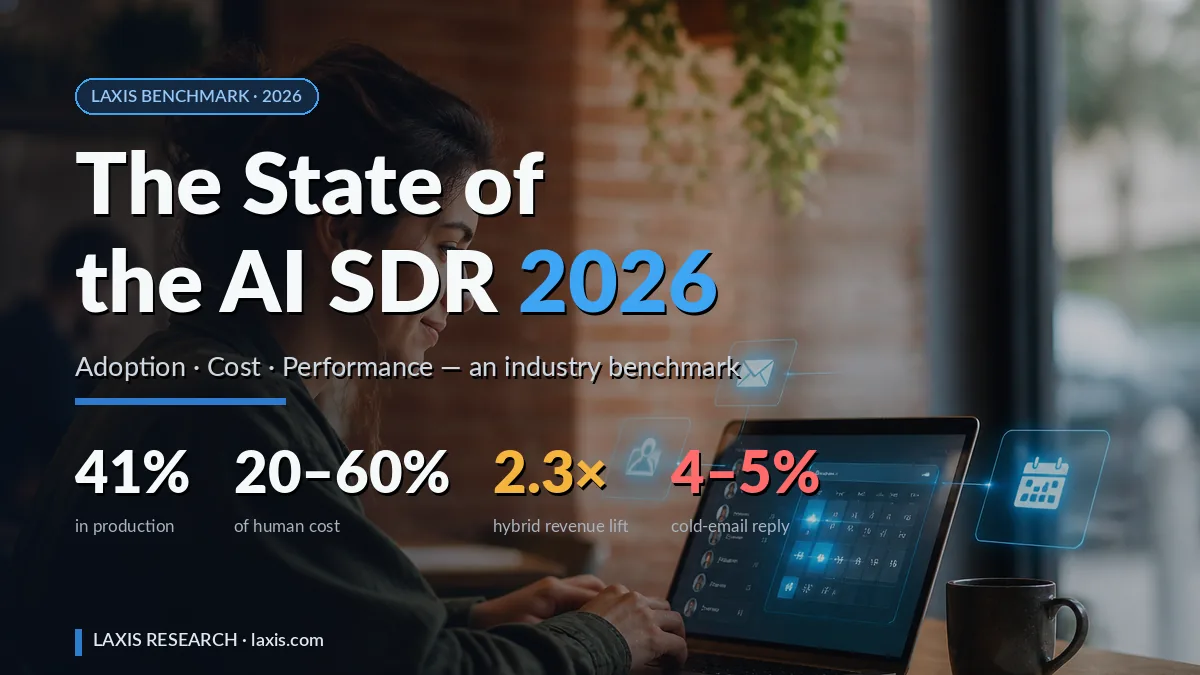
- 41% — Of enterprise B2B teams had an AI SDR in production in Q1 2026 — up from ~12% a year earlier
- 20–60% — An AI SDR's cost as a share of a human SDR's fully loaded cost
- $224 vs $487 — Cost per qualified opportunity: hybrid pods vs human-only pods
- 10–50× — Activity volume an AI SDR can run versus a single human rep
- 2.3× — More revenue from a hybrid pod than an AI-only setup in a controlled test
- 60–70% — Show rate for AI-booked meetings vs 75–85% for human-booked
- ~4–5% — B2B cold-email reply rate in 2026, down from ~6.8% in 2023
- 47% — Of AI SDR deployments capped by domain-reputation collapse within 90 days
For two years the AI SDR was sold as a replacement for the entry-level sales rep — cheaper, tireless, infinitely scalable. In 2026 the market got its reality check. The technology works, adoption is climbing fast, and the cost math is genuinely compelling. But the teams getting real pipeline out of it look almost nothing like the "fire the SDR team" pitch that launched the category. This report compiles the most credible recent data on AI SDRs to answer the questions buyers actually have: how many people are using them, what they really cost, how well they perform, and where they quietly break.
One framing note. The AI SDR is the top-of-funnel slice of the broader AI sales agent — focused specifically on prospecting, outreach, and booking meetings. If you want the wider view across the full sales cycle, see our companion State of AI Sales Agents 2026. Here, we stay in the funnel's first mile.
1. Adoption: The Curve Bent Sharply Upward
The headline adoption number tells the story of a category crossing the chasm. As of Q1 2026, 41% of enterprise B2B teams had an AI SDR in production — up from roughly 12% just a year earlier. That's a more than 3× jump in twelve months, and "in production" is the operative phrase: this is real outbound running through these systems, not sandbox trials.
The market figures track the same trajectory. Estimates put the AI SDR market at around $4.4–4.8 billion in 2026, with projections reaching roughly $17.6 billion by 2030 at a ~32% CAGR. Whatever the exact figure, the direction is unambiguous: outbound prospecting is being rebuilt around AI faster than almost any other sales workflow.
Sources: Sushidata State of the AI SDR 2026; Clara AI SDR Statistics 2026; DigitalApplied AI SDR Statistics; Salesmotion AI SDRs vs Human SDRs; Prospect AI Cost Comparison. Market sizing is blended analyst estimate; ranges reflect methodology differences.
2. The Cost Math: Why CFOs Said Yes
The reason adoption moved this fast isn't subtle. An AI SDR license typically costs 20–60% of a human SDR's fully loaded cost — and the gap at the team level is dramatic. A team of five human SDRs runs roughly $440,000–$655,000 a year once you include salary, commission, benefits, tooling, and management overhead. An AI SDR stack covering comparable activity volume might run $40,000–$120,000.
But raw cost is the wrong metric, and the smartest 2026 buyers have moved past it. The number that matters is cost per qualified opportunity, and there the picture is more interesting: it runs about $487 in human-only pods versus $224 in hybrid AI-plus-human pods — a 54% reduction. Notice that the cheapest configuration on paper (fully autonomous AI) is not the one that produces the lowest cost per qualified opportunity. Volume is cheap; qualified pipeline is what you're actually buying.
Quick tip: When you build the business case, don't compare "AI SDR cost" to "human SDR cost." Compare cost per qualified opportunity across three configs — human-only, AI-only, and hybrid. The hybrid number almost always wins, and it's the only comparison that survives contact with your actual pipeline.
3. Performance: Volume Is Easy, Quality Is Not
Here's where the "replace the team" pitch falls apart. Yes, an AI SDR can run 10–50× the activity of a human rep. But activity and outcomes diverge hard at the point of conversion.
The most-cited controlled test of 2026 makes it concrete. An AI-only setup booked 847 meetings at 11% conversion; a hybrid setup booked 312 meetings at 38% conversion. The hybrid generated roughly 2.3× more revenue despite booking less than half as many meetings. More meetings made the dashboard look impressive and the pipeline look thin.
Show rates compound the gap. AI-booked meetings show at 60–70%, while human-booked meetings show at 75–85% — because a prospect who agreed to a meeting with a person who understood their problem is more likely to actually turn up than one who clicked a calendar link inside an automated thread.
| Metric | AI-only | Hybrid (AI + human) | Human-only |
|---|---|---|---|
| Meeting volume | Very high (10–50×) | Moderate | Low |
| Conversion to opportunity | ~11% | ~38% | High |
| Meeting show rate | 60–70% | ~75%+ | 75–85% |
| Cost per qualified opp | Low headline, weak yield | ~$224 | ~$487 |
4. The Reply-Rate Squeeze
The macro headwind every AI SDR runs into: inboxes are fighting back. B2B cold-email reply rates have drifted from about 6.8% in 2023 to roughly 4–5% in 2025–2026, as Gmail and Microsoft tuned their filters specifically against the patterns AI-generated outreach produces. The very thing that makes AI SDRs scalable — volume — is what the filters are trained to catch.
The spread by approach is stark. Fully autonomous agents land at 1–3% reply rates and $250–$400 per qualified meeting. Signal-driven, human-supervised outreach — fewer sends, triggered by real buying signals — hits 15–25% reply rates at $80–$180 per qualified meeting. Same underlying AI; very different discipline around how it's pointed.
The decay nobody budgets for: "Reply-quality drift" — the steady decline in reply rate as personalization templates exhaust and sender reputation degrades — typically knocks 30–50% off peak performance by week 8 on autonomous platforms. The launch numbers in a vendor demo are almost never the week-12 numbers.
5. Deliverability: The Silent Deployment Killer
If there's one finding that should reshape how teams buy AI SDRs in 2026, it's this: domain-reputation collapse from over-sending now caps 47% of attempted AI SDR deployments within the first 90 days. Nearly half of all deployments hit a wall not because the AI wrote bad copy, but because it sent too much, too fast, from domains that weren't ready.
The mechanics are unforgiving and well documented. Domains warmed under 30 days land at about 51% inbox placement; 60–90 days reaches 86%; 90+ days hits 91%. Experienced teams now cap cold sends at roughly 25 emails per mailbox per day and allow 60–90 days of throttled warmup before scaling any sequence. Microsoft 365 inboxes are the strictest filter of all.
This is exactly the work a fully autonomous agent is built to skip — and exactly the work that determines whether the deployment survives. It's also why deliverability infrastructure and human oversight, not raw autonomy, emerged as the real differentiators this year.
Quick tip: Before you judge an AI SDR on copy or targeting, audit the boring layer: how many sending domains and mailboxes, what the warmup schedule is, and the daily send cap per mailbox. A tool that lets you blast 200 emails a day per mailbox isn't powerful — it's a domain-reputation liability with a nice UI.
6. The Verdict: Augment, Don't Replace
Put the numbers together and the 2026 conclusion writes itself. Fully autonomous AI SDRs win on volume and lose on everything that turns into revenue — conversion, show rate, deliverability, durability. Human-only teams win on quality and lose on cost and reach. The configuration that wins on the metric that matters — qualified pipeline per dollar — is the hybrid.
The division of labor that's emerging is clear: AI does the research, the first-draft copy, the list building, and the follow-up logistics; humans protect sender reputation, write the personalization that doesn't read as robotic, handle objections, and own the strategy. The AI SDR didn't replace the rep. It removed the parts of the job that were never the point — and let a smaller team of humans cover far more ground.
The reframe: The question stopped being "AI SDR or human SDR?" The teams pulling ahead ask "how do I give each human SDR an AI that does the 80% of the job that's research and logistics, so the human spends their hours on the 20% that's judgment?"
7. What This Means for Sales Teams in 2026
If you're building or rebuilding an outbound motion this year, the data points to a specific shape. Buy for the hybrid model, not the autopilot fantasy. Judge tools on cost per qualified opportunity and deliverability discipline, not on emails-sent or meetings-booked vanity counts. Assume reply rates will keep drifting down and that whatever launches at 8% will settle lower — so the system has to protect its sender reputation as carefully as it writes its copy.
And insist that the prospecting layer connects to the rest of the cycle. An AI SDR that books a meeting and then forgets it the moment the calendar invite goes out is leaving most of its value on the table. The next outbound move should be informed by what happened in the last conversation — which is only possible when prospecting, meetings, and CRM live in one connected loop instead of four disconnected tools.
Give every rep an AI SDR that books the meeting — and remembers it
Laxis runs research, multi-channel outreach across email, LinkedIn, SMS, WhatsApp, and AI phone, qualifies replies, and books meetings — then records, transcribes, and syncs to your CRM so the meeting outcome shapes the next touch. Built for the hybrid model that actually wins.
Frequently Asked Questions
How many companies use AI SDRs in 2026?
About 41% of enterprise B2B teams had an AI SDR in production as of Q1 2026, up from roughly 12% a year earlier. The AI SDR market is estimated at around $4.4–4.8 billion in 2026 and projected to reach about $17.6 billion by 2030 at a ~32% CAGR.
How much does an AI SDR cost vs a human SDR?
An AI SDR license typically costs 20–60% of a human SDR's fully loaded cost. A team of five human SDRs runs roughly $440,000–$655,000 per year, while an AI SDR stack covering comparable volume might run $40,000–$120,000. More importantly, cost per qualified opportunity drops from about $487 in human-only pods to around $224 in hybrid pods.
Do AI SDRs book as many qualified meetings as humans?
AI SDRs can run 10–50× the activity of a human rep, but quality varies sharply. In one controlled test, an AI-only setup booked 847 meetings at 11% conversion while a hybrid booked 312 at 38% — the hybrid produced about 2.3× more revenue. AI-booked meetings also show at 60–70% versus 75–85% for human-booked.
Why are cold email reply rates dropping for AI SDRs?
B2B cold-email reply rates drifted from about 6.8% in 2023 to roughly 4–5% in 2025–2026 as Gmail and Microsoft tuned filters against AI-generated outreach. Fully autonomous agents land at 1–3%, while signal-driven, human-supervised outreach reaches 15–25%. Reply quality also decays 30–50% by week 8 as templates exhaust and sender reputation degrades.
Is it better to use an AI SDR or hire a human SDR in 2026?
The data favors a hybrid model over either extreme. AI handles research, first-draft copy, list building, and follow-up logistics at scale; humans protect sender reputation, write natural personalization, handle objections, and own strategy. Hybrid AI-plus-human pods deliver more qualified pipeline per dollar than either fully autonomous AI or human-only teams.
Methodology & Sources
This report aggregates and analyzes recent (2025–2026) industry data on AI SDRs and outbound sales from Sushidata, Clara AI SDR, Salesmotion, Prospect AI, DigitalApplied, Apollo, UnifyGTM, Coldreach, and Laxis internal benchmarks across customer workspaces. Where source estimates diverge, we report ranges and indicate the methodology behind each figure. All figures reference B2B outbound contexts unless otherwise noted. This report is intended as a citation-friendly reference; sources are named alongside each major figure to support journalist and analyst use.
Cite this report
Laxis Research. (2026). The State of the AI SDR 2026: Adoption, Cost & Performance Benchmarks. Laxis. https://www.laxis.com/blog/state-of-ai-sdr-2026