2026年版ミーティングの実態:件数・コスト・生産性のベンチマークレポート
The State of Meetings 2026 — Key Findings
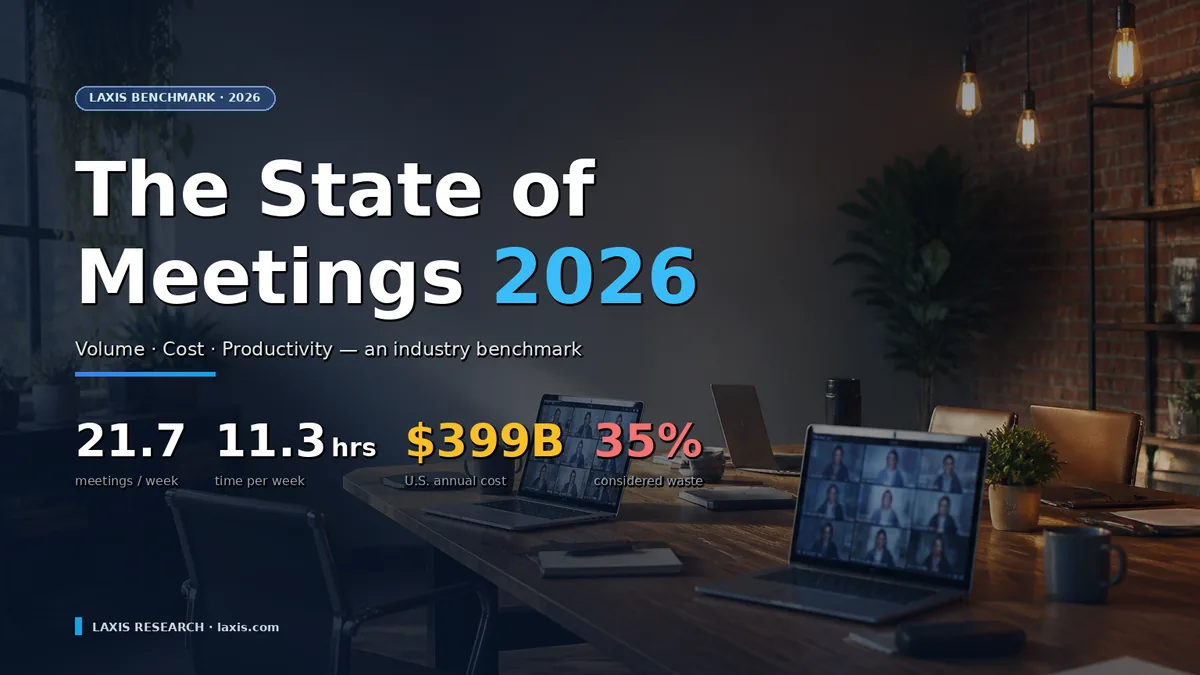
- 21.7 — Average meetings per knowledge worker, per week
- 11.3 hrs — Average time spent in meetings each week — 28% of the workweek
- $399B — Annual U.S. cost of unproductive meetings (high-end estimate)
- 35% — Of all business meetings are considered a waste of time
- 98% — Of organizational meetings now include at least one remote participant
- 70% — Of decisions are forgotten within 24 hours when no follow-up notes are shared
- 76% — Of workers feel drained on days with a heavy meeting load
- 47 min — Average meeting length — down from 51 minutes in 2023
Meetings have changed more in the past five years than in the previous fifty. Remote and hybrid work have reshaped the rhythm of how teams gather. Calendars are denser. Meetings are shorter, more frequent, and more often hybrid. Almost every meeting now has at least one screen in it. And while the technology around meetings has accelerated, the underlying human cost — time, focus, and the slow erosion of follow-through — has gotten worse, not better.
This report compiles the most credible recent data on workplace meetings and analyzes what it means for teams that want to keep collaborating without burning out. We focus on three questions: How much are we meeting? What is it costing us? What's actually getting better?
1. Meeting Volume: The Calendar Has Never Been Denser
The single most striking finding in 2026 is that meeting volume continues to climb — even after years of executive pledges to do something about it. Multiple independent data sets now converge on the same picture.
The average knowledge worker now attends 21.7 meetings per week, blending in-person, video, and quick check-ins. Microsoft's Work Trend Index pegs total time in meetings even higher — about 15.4 hours per week, against just 12.1 hours of uninterrupted focus work. Meeting volume has risen 252% since February 2020, and the growth curve has not flattened.
Sources: Speakwise Meeting Overload Statistics 2026; Pumble Meeting Statistics 2026; Microsoft Work Trend Index. Manager average reflects director-and-above weighted distribution.
Volume is not evenly distributed. Solo professionals and small teams average roughly 12 meetings per week; staff at enterprises with 500+ employees average 18. Individual contributors hover near the bottom of the curve, while managers and executives can land north of 22 meetings weekly, with director-level employees regularly losing more than half of every working day to scheduled gatherings.
The meeting-time paradox: Even as average meeting length dropped from 51 to 47 minutes, the number of meetings nearly doubled over the same period. Teams are running shorter, more frequent gatherings — which feels more agile but produces more total time in meetings, more context-switching, and less focus time per day.
The shrinking focus window
For the typical knowledge worker, 11.3 hours per week sits in meetings; another 3–4 hours sit in adjacent meeting overhead — preparation, follow-up, recap notes, and the buffer time around back-to-back calls. By 2026, the median uninterrupted focus block has narrowed to roughly 20 minutes before the next interruption. This is the largest single driver of the modern productivity complaint: meetings haven't gotten worse on average, but the spaces between them have collapsed.
2. The Real Cost of Meetings in 2026
If your company has 5,000 employees, you are almost certainly losing more than $100 million per year to meetings that participants themselves recognize as wasteful. The numbers are blunt, and they have not improved meaningfully since the last cycle of "meeting hygiene" advice.
The most cited industry estimate puts the annual U.S. cost of unproductive meetings at $399 billion, with about 24 billion person-hours wasted each year. Per employee, the cost lands near $25,000 annually — a number that has scaled with wages even as remote work theoretically made meetings cheaper to convene.
Translation: roughly 6 out of every 10 meeting hours are categorized by workers as waste. The biggest opportunity isn't shorter meetings — it's fewer recurring meetings, sharper agendas, and a written record that lets people skip what doesn't apply.
The cost is not only financial. The opportunity cost is the work that didn't happen. A 392-hour annual meeting load equals 9.8 full workweeks per employee, every year. For a 200-person company, that's the equivalent of 19 full-time roles' worth of productive capacity locked inside Zoom rooms.
The hidden tax: tech friction
72% of workers lose time during meetings to technical issues — audio dropouts, video freezes, login problems, screen-share fights. Owl Labs found that hybrid meetings carry a structural participation gap: remote attendees speak 25% less than in-room participants, and 55% of hybrid attendees report difficulty contributing equally when some teammates are in the room and others are not. That's an invisible cost that no dashboard reports on but it shows up in attrition, escalations, and the slow drift of decisions away from your remote talent.
3. The Modality Shift: Almost Every Meeting Is Now Hybrid
The most consequential structural change is one that's easy to miss because it happened gradually: 98% of organizational meetings now include at least one remote participant. The "in-person meeting" as a default is gone. Even teams that have returned to the office five days a week schedule almost every cross-functional call as a video meeting — because somebody is always on the road, on PTO, or in another office.
This has practical implications. Every meeting is now a recording opportunity. Every meeting has a transcript-able audio stream. And every meeting produces a written artifact whether teams use one or not. The companies that have embraced this — by treating meeting audio as default-captured and default-summarized — are operating at a measurably different speed than companies still relying on the manual note-taker model.
| Work mode | Video calls / week | Reported fatigue | Reported burnout |
|---|---|---|---|
| Remote-first | 7.3 | 52% | 42% |
| Hybrid | 4.1 | 41% | 29% |
| Fully in-office | 2.6 | 33% | 31% |
Worth noticing: in-office workers do not report less burnout than hybrid workers in 2026 data. The "return to office solves burnout" narrative is not supported by the underlying numbers — what reduces burnout is meeting density, not modality.
Camera fatigue is real and measurable: 49% of U.S. employees now report experiencing virtual meeting fatigue. The leading correctible cause isn't time on video — it's back-to-back scheduling with no buffer. Companies that mandated 25-minute and 50-minute meetings (instead of 30/60) saw measurable improvements in afternoon focus scores.
Async is rising — but slowly
Async-first replacements for status meetings have been gaining ground in software, design, and customer-success teams, but the broader migration has been slower than predicted. The reason isn't that async is unpopular. It's that async requires writing, and writing is harder than meeting. In 2026, the teams that have actually moved status updates to async are nearly always the teams that adopted AI summarization first — because AI took the writing burden off the humans who would have had to do it.
4. The People Cost: Burnout, Fatigue, and the Generational Split
76% of workers agree they feel drained on heavy meeting days. 65% report being mentally exhausted by the end of any day dominated by calls. And 82% of white-collar workers reported being slightly to extremely burned out heading into 2025 — a figure that has held essentially flat through 2026.
The generational pattern is one of the most under-discussed findings in this year's data. 75% of Gen Z and 77% of millennials prefer hybrid or fully remote work, and Gen Z in particular show strong preferences for asynchronous, messaging-first communication. Yet 42% of Gen Z still value face-to-face interaction for important topics — they don't want fewer meetings, they want meetings that matter and async for everything else.
The hidden burnout signal: "couldn't recall key details" and "worked nights to catch up" — the people cost of meetings that aren't recorded, summarized, and searchable.
5. The Memory Layer: Why Decisions Don't Stick
Of all the data points in this report, one is so consistent across sources it's worth treating as a stylized fact: without follow-up notes, 70% of meeting decisions are forgotten within 24 hours. That's not a statement about people's memory. It's a statement about the way human conversation produces information faster than human attention can encode it.
The downstream effects are everywhere. 40% of "least productive" meetings are characterized — by their own attendees — as lacking follow-up notes or clear action items. Manual action-item completion rates sit at 50–60%. Teams using AI-generated meeting notes report 50–70% better follow-through on action items, with completion rates climbing into the 85–95% range.
This is the single biggest lever in modern collaboration. You can't shrink the number of meetings overnight. You can't change human attention spans. But you can change whether the meeting produces a durable, searchable artifact — and that one change moves more outcomes than any agenda template ever has.
The 40-minute follow-up: In 2026, the median knowledge worker spends 40 minutes after every two hours of meetings writing, formatting, and distributing notes — and frequently does it imperfectly, missing nuance, omitting action items, or never sharing the doc at all. AI meeting assistants eliminate this overhead almost entirely while improving consistency.
6. What's Actually Working in 2026
The most measurable improvements in 2026 meeting data come from three concrete practices, not from new philosophies of work.
a) Default capture and AI summarization
Companies that turned on default meeting capture — every meeting recorded, transcribed, and summarized — report 20–40% reductions in meeting length within six months. The mechanism is simple: when attendees know there's a searchable record, they stop asking the recap questions, stop scheduling "alignment" meetings to clarify what was said, and start linking to timestamps in chat instead.
b) Shorter default durations
The shift from 30-minute and 60-minute defaults to 25 and 50 minutes is the highest-ROI calendar change ever measured: a free 10 minutes of buffer between every meeting, with no apparent loss in meeting outcomes. Microsoft, Salesforce, and a wave of mid-market companies have made this the default at the calendar level.
c) Agenda-or-cancel norms
"If there is no agenda by the morning of, the meeting is canceled." Teams that adopt this norm see meeting volume fall by 15–22% within a quarter — because most of what gets canceled was a status check that didn't need a meeting in the first place.
d) Async-first weekly updates
Replacing the weekly all-hands status meeting with a Loom-or-doc update and an open Q&A thread saves the equivalent of 3.5 hours per person per quarter. The catch: it only sticks if the company actually reads the updates. The Loom view-rate matters more than the meeting attendance rate did.
7. What This Means for Teams Operating in 2026
If you take only one data point from this report, take this one: the cost of meetings is no longer the time you spend in them. It's the memory you lose between them, the decisions that don't get acted on, and the focus time that gets shredded by back-to-back calls with no buffer.
The fix is not "fewer meetings" — that fight has been lost. The fix is treating meeting output as infrastructure. Default-on capture, an AI summary distributed before the next standup, action items in your CRM or project tool before the meeting ends, and a searchable institutional memory anyone on the team can query: that is what separates the companies that are accelerating from the ones that are running back-to-back Zooms and calling it work.
This is also, not coincidentally, where the next year of investment is going. AI meeting assistants are no longer a productivity nice-to-have — they're the substrate on which async collaboration, sales operations, customer success, and internal knowledge management are increasingly being built.
Turn meeting output into a system, not a chore
Laxis records, transcribes, and summarizes every meeting in real time — bot-free capture, instant action items, CRM sync, and a searchable knowledge base across your entire meeting history. Free up the hours your team currently spends rewriting what they already said.
Frequently Asked Questions
How many meetings does the average person attend per week in 2026?
The average knowledge worker attends about 21.7 meetings per week, blending video, in-person, and hybrid calls. The number varies significantly by role and company size: individual contributors at small companies average around 12 per week, while managers at enterprises (500+ employees) average 22 or more.
How many hours does the average worker spend in meetings per week?
Around 11.3 hours per week, or roughly 28% of the standard workweek. Microsoft's Work Trend Index puts the figure slightly higher for senior knowledge workers, at about 15.4 hours per week. Over a year, that adds up to roughly 392 hours — the equivalent of about 10 full workweeks.
How much do meetings cost businesses?
Industry estimates put the annual U.S. cost of unproductive meetings between $37 billion and $399 billion, depending on methodology. Per employee, the cost lands near $25,000 per year in wasted time alone, climbing to over $100 million annually for a 5,000-person organization.
What percentage of meetings are considered unproductive?
Roughly 35% of all business meetings are considered a waste of time by their own attendees, and some sources put the figure as high as 72% when including meetings that "could have been an email." The biggest drivers are unclear agendas, wrong attendees, and a lack of post-meeting follow-up.
Are meetings getting shorter in 2026?
Yes — slightly. The average meeting length has dropped from 51 minutes to 47 minutes. But the total time spent in meetings hasn't fallen, because the number of meetings has grown faster than the average length has shrunk. The net result is more meetings, more context-switching, and shorter focus blocks between them.
What share of meetings are hybrid or remote?
98% of organizational meetings now include at least one remote participant, and 64% of employees name hybrid video meetings as their preferred meeting style. The "fully in-person" meeting has become the exception, even for teams that have returned to the office full time.
Why are so many meeting decisions forgotten?
Without follow-up notes, 70% of decisions made in meetings are forgotten within 24 hours. The cause is structural, not personal: human attention encodes spoken information much more slowly than it produces it. Teams that adopt AI-generated meeting summaries see action-item completion rates rise from 50–60% to 85–95%.
What's the single most effective change a team can make to its meeting culture?
Default-on capture and AI summarization. Companies that record, transcribe, and auto-summarize every meeting report 20–40% reductions in meeting length and dramatic improvements in action-item follow-through — primarily because the searchable record eliminates the "alignment meetings" that get scheduled to clarify what was said in earlier meetings.
Methodology & sources
This report aggregates and analyzes recent (2025–2026) industry data on workplace meetings from Microsoft Work Trend Index, Owl Labs State of Hybrid Work, Pumble, Speakwise, Flowtrace, Fellow, Atlassian, and Laxis internal benchmarks across thousands of customer workspaces. Where source estimates diverge, we report ranges and indicate the methodology behind each figure. All employee counts are U.S. knowledge-worker averages unless otherwise noted. This report is intended as a citation-friendly reference; sources are explicitly named with each figure to support journalist and analyst use.
Cite this report
Laxis Research. (2026). The State of Meetings 2026: Benchmark Report on Meeting Volume, Cost & Productivity. Laxis. https://laxis.com/blog/state-of-meetings-2026