2026 年 AI 销售代理现状:采用率、ROI 与市场基准
The State of AI Sales Agents 2026 — Key Findings
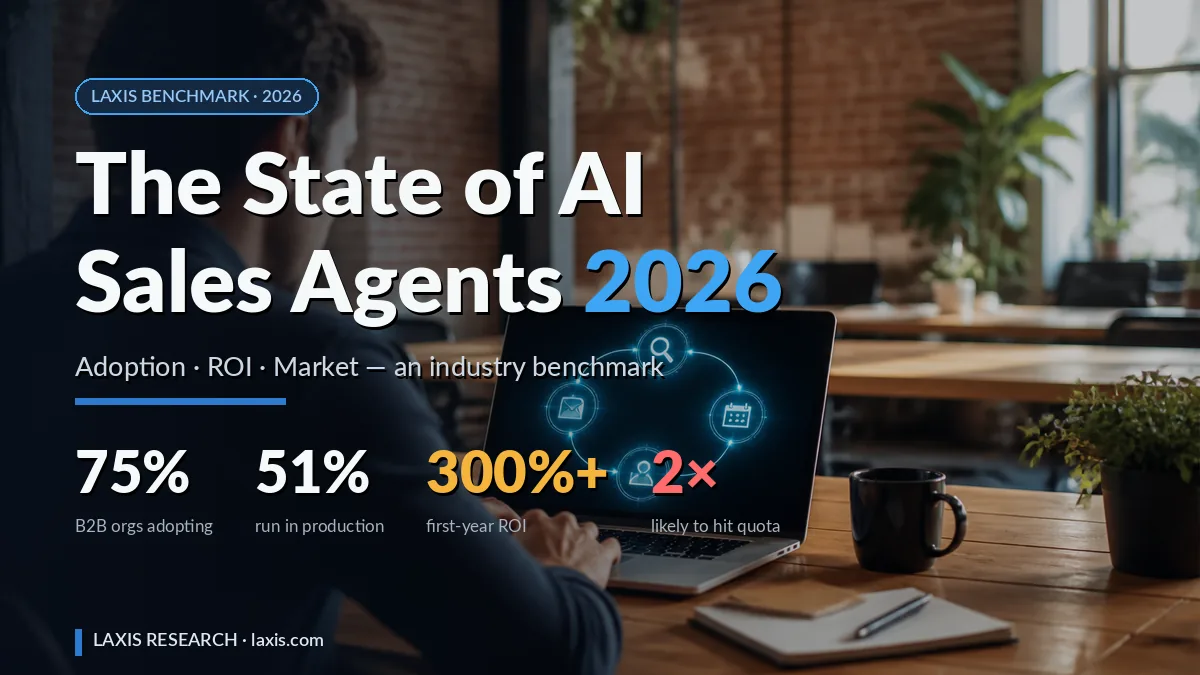
- ~$11–12B — Projected 2026 AI agents market, growing 45%+ CAGR
- 75% — Of B2B sales organizations expected to use AI-driven sales development by end of 2026
- 51% — Of enterprises now run AI agents in production
- 40% — Of enterprise applications embed AI agents in 2026 — up from under 5% in 2025
- 300–500% — Typical first-year ROI reported for AI sales agents
- 9–12 mo — Realistic payback period when utilization stays above 75%
- 3–15% — Revenue growth reported by companies deploying agents broadly
- 2× — AI-assisted reps are roughly twice as likely to hit quota
The "AI sales agent" stopped being a demo in 2026. It became a line item. Somewhere between the autopilot hype of 2024 and the deliverability hangover of 2025, sales leaders quietly figured out what these systems are actually good at — and where they quietly burn money. This report pulls together the most credible recent data to answer three questions: how fast are AI sales agents really being adopted, what return are they producing, and what separates the deployments that work from the ones that stall?
A quick definition, because the category is muddy. An AI sales agent is software that takes action across the sales cycle — researching accounts, drafting and sending outreach, qualifying replies, booking meetings, and updating the CRM — with varying degrees of autonomy. That's broader than an "AI SDR," which is the top-of-funnel slice of the same idea. This report looks at the whole agent; our companion State of AI SDR 2026 zooms into the prospecting layer specifically.
1. The Market: From Novelty to Default Budget Line
The numbers around agentic AI are big enough to be almost meaningless on their own — so the useful signal is the rate of change, not the headline. Multiple analysts now put the broader AI agents market somewhere around $11–12 billion in 2026, up from roughly $7.6–8.3 billion in 2025, on a growth curve north of 45% a year. Within that, the autonomous-agent slice alone reached about $5.83 billion.
Sales is one of the functions pulling that curve upward fastest. The most-cited 2026 projection holds that 75% of B2B sales organizations will incorporate some form of AI-driven sales development by year-end. That's not "experimenting with" — that's putting agents into the revenue motion.
Sources: SQ Magazine AI Agent Autonomy Statistics 2026; Cyntexa Agentic AI Statistics 2026; Salesmate AI Agent Adoption; Envive 44 AI Sales Agent Statistics. Market figures are blended analyst estimates; ranges reflect methodology differences.
The more telling enterprise statistic is structural: by 2026, roughly 40% of enterprise applications embed AI agents, up from under 5% a year earlier. The agent is no longer a standalone product you log into — it's becoming a feature of the tools sales teams already use. That shift is what turns adoption from a pilot into a default.
2. Adoption: Wide, but Uneven and Mostly Early
Breadth and depth are two different stories in 2026. On breadth, around 79% of organizations report some level of agentic AI adoption, and 96% say they plan to expand it. On depth, only about 51% of enterprises run AI agents in production — meaning roughly half of the "adopters" are still in pilots, sandboxes, or single-team trials.
That gap between "we're using AI agents" and "AI agents are doing real work in production" is the single most important context for any 2026 statistic. A lot of the disappointing-ROI stories trace back to deployments that never made it past the pilot stage, where an agent runs on a clean test list and nobody has wired it into the CRM or the deliverability stack.
Buyer's tip: Before you compare vendors, decide whether you're buying a pilot or a production system. The questions are different. For production, the first three you should ask are: Does it write back to my CRM both ways? Does it manage sender reputation and warmup? And does it carry context from outreach into the meeting and back out into the next touch?
3. The ROI Question: Real, but Conditional
Here's the figure everyone quotes: AI sales agents deliver 300–500% ROI in the first year. It's real, and it's also conditional in ways the headline hides. The same analyses that report those returns are blunt about the conditions: payback runs 9–12 months when utilization stays above 75%, and the whole equation collapses without automatic two-way CRM write-back.
That last clause does more work than any percentage. If the agent sends and books but the data doesn't flow back into the system reps actually live in, the team stops trusting it, stops using it, and the utilization that the ROI depends on never materializes. The agents that pay back aren't the smartest — they're the ones nobody has a reason to ignore.
On the revenue side, companies deploying agents broadly report 3–15% revenue growth and 10–20% increases in sales ROI. At the individual level, LinkedIn data found AI-assisted reps save more than 1.5 hours a week on research, lift response rates by around 28%, shorten cycles by roughly a week — and are about twice as likely to hit quota.
Translation: The agent's value isn't "it replaces a rep." It's "it removes the unpaid administrative tax — research, logging, follow-up drafting — that was quietly eating a third of every rep's week." That's why the ROI shows up as quota attainment, not headcount reduction.
4. The Autonomy Paradox: Why Fully Autonomous Lost in 2026
The biggest narrative correction of the year is about autonomy itself. In 2024, the pitch was "set it and forget it." By 2026, the data has a clear verdict: more autonomy does not mean more revenue.
The cleanest illustration comes from controlled tests comparing fully autonomous setups against hybrid human-plus-AI pods. An autonomous-only configuration booked far more raw meetings, but at low conversion; the hybrid setup booked roughly a third as many meetings at more than triple the conversion rate — and generated about 2.3× more revenue despite the lower meeting count. Quantity is cheap. Qualified pipeline is not.
| Configuration | Meeting volume | Conversion to opportunity | Relative revenue |
|---|---|---|---|
| Fully autonomous | Very high | ~11% | 1.0× |
| Hybrid (AI + human) | Lower | ~38% | ~2.3× |
The emerging consensus is a division of labor, not a handoff: AI handles research, first-draft copy, list building, sequencing, and follow-up logistics; humans protect sender reputation, inject the personalization that doesn't sound robotic, and stop the sends that would burn a domain or a relationship. The winning system in 2026 is an agent with a human holding the steering wheel — not a human watching an agent drive.
Why this matters for tooling: A platform built for full autonomy optimizes for volume and removes the human checkpoints. A platform built for the hybrid model surfaces decisions to a person at the moments that matter — copy approval, escalation, reputation risk — without making them do the grunt work. Buy for the model that actually wins.
5. Where the Money Leaks
If 51% of enterprises are in production and ROI is conditional, the obvious question is: what goes wrong in the deployments that disappoint? Three failure modes dominate the 2026 data.
Broken CRM write-back. The single most-cited killer. When the agent's activity doesn't reliably land in the CRM, reps lose trust, double-enter data, or simply route around the tool. ROI depends on utilization, and utilization depends on trust.
Deliverability damage. Agents that optimize for send volume drive domain reputation into the ground. Reputation collapse from over-sending caps a startling share of AI outbound deployments within their first 90 days — the kind of self-inflicted wound that no conversion-rate tweak can fix once it happens. (We cover the deliverability mechanics in depth in the State of AI SDR 2026.)
Fragmentation. Most teams assembled their stack from point tools — one for data, one for sending, one for meeting notes, one for CRM sync. Every handoff between tools is a place where context dies. The prospect's research never reaches the meeting; the meeting outcome never reaches the next touch. The agent looks busy and the pipeline stays flat.
6. The Shift Toward End-to-End Agents
The structural response to fragmentation is consolidation. The most measurable 2026 gains are coming from teams that stopped stitching together five tools and moved to a single agent that carries context across the whole cycle: the same system finds the prospect, reaches them across channels, records and transcribes the meeting, and uses the meeting outcome to inform the next outbound move.
This is where conversational intelligence and the sales agent finally converge. For years, "conversation intelligence" (recording and analyzing calls) and "sales engagement" (sending and sequencing) were separate categories. In 2026 they're collapsing into one loop, because the data each produces is exactly what the other needs. An agent that knows what happened in the last meeting writes a dramatically better follow-up than one firing blind from a template.
The compounding effect: A connected agent gets smarter with every campaign — analyzing which subject lines, value propositions, and sequences drive responses, and feeding meeting outcomes back into targeting. A fragmented stack starts from zero every Monday.
7. What This Means for Sales Teams in 2026
If you take one thing from this report, take this: the AI sales agent is no longer a question of whether, and barely a question of which features. It's a question of architecture. The teams pulling ahead aren't the ones with the most autonomous bot — they're the ones who treated the agent as infrastructure: connected to the CRM, protective of deliverability, and able to carry context from the first touch through the meeting and into the next move.
The agents that lose are point solutions optimized for a vanity metric — emails sent, meetings booked — disconnected from the systems where revenue actually gets recorded. The agents that win are boring in the best way: they show up in the CRM, they don't torch your domain, and they make every rep about twice as likely to hit quota. That's not science fiction anymore. In 2026, it's the new baseline.
Run one agent across the whole sales cycle — not five tools that forget each other
Laxis finds prospects, reaches them across email, LinkedIn, SMS, WhatsApp, and AI phone, books the meeting, records and transcribes it, syncs to your CRM, and uses the outcome to inform the next move. One connected loop, not a fragile stack.
Frequently Asked Questions
How big is the AI sales agent market in 2026?
The broader AI agents market is projected at roughly $11–12 billion in 2026, up from about $7.6–8.3 billion in 2025, growing at more than 45% CAGR. Sales is one of the fastest-adopting functions: an estimated 75% of B2B sales organizations expect to use some form of AI-driven sales development by the end of 2026.
What ROI do AI sales agents deliver?
Reported first-year ROI commonly lands in the 300–500% range, with realistic payback of 9–12 months when utilization stays above 75%. Companies deploying agents broadly report 3–15% revenue growth and 10–20% increases in sales ROI. The returns collapse without automatic two-way CRM write-back, which is the most common point of failure.
Are autonomous AI sales agents better than human-in-the-loop?
On revenue, no. In 2026 controlled tests, fully autonomous setups book more raw meetings but convert far worse, while hybrid human-plus-AI pods generate roughly 2.3× more revenue from fewer, higher-quality meetings. The winning model has AI handle research, drafting, and sequencing while humans protect deliverability and handle nuance.
What share of enterprises run AI sales agents in production?
About 51% of enterprises run AI agents in production in 2026, and roughly 40% of enterprise applications now embed AI agents, up from under 5% in 2025. Around 79% of organizations report some level of agentic AI adoption, and 96% plan to expand it — but roughly half of adopters are still in pilots rather than production.
Why do AI sales agents fail to deliver ROI?
The three dominant failure modes are broken CRM write-back (reps stop trusting and using the tool), deliverability damage from over-sending (domain reputation collapse early in deployment), and fragmentation (context dies in the handoffs between point tools). The fix is an end-to-end agent that stays connected to the CRM and carries context across the cycle.
Methodology & Sources
This report aggregates and analyzes recent (2025–2026) industry data on AI sales agents and agentic AI from SQ Magazine, Cyntexa, Salesmate, Azumo, Warmly, Envive, Instantly, Jeeva, Apollo, LinkedIn's sales data, and Laxis internal benchmarks across customer workspaces. Where source estimates diverge, we report ranges and indicate the methodology behind each figure. All figures reference B2B sales contexts unless otherwise noted. This report is intended as a citation-friendly reference; sources are named alongside each major figure to support journalist and analyst use.
Cite this report
Laxis Research. (2026). The State of AI Sales Agents 2026: Adoption, ROI & Market Benchmarks. Laxis. https://www.laxis.com/blog/state-of-ai-sales-agent-2026