All Hands Meeting: What It Is + How to Run One
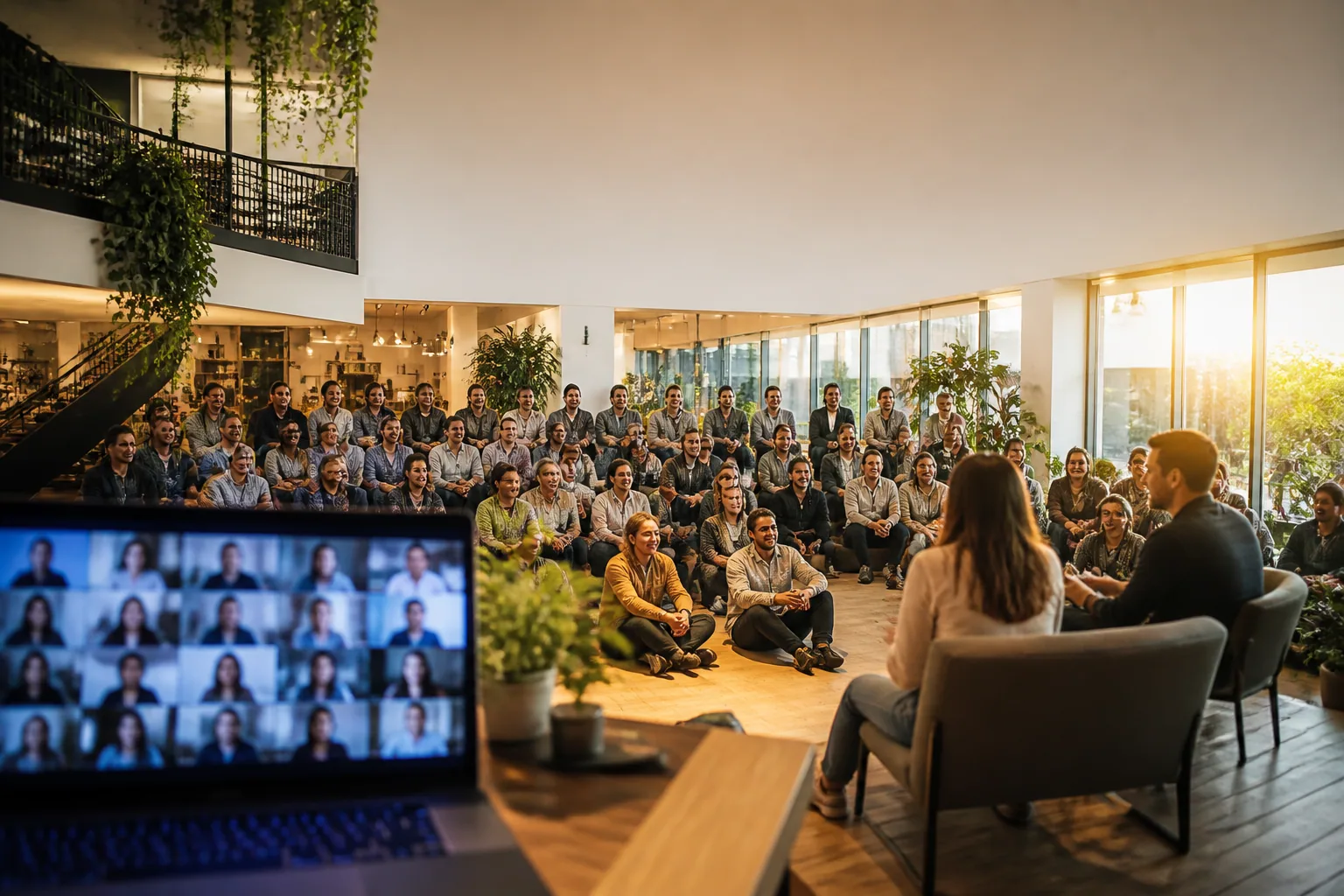
Twelve minutes in, the VP of Operations reaches slide nine of fourteen and starts reading the sub-bullets out loud. In the gallery view, cameras go dark in ones and twos, like windows in an office building at nine at night. Nobody's being rude. They've simply worked out that nothing in the next twenty minutes requires them.
That's the standard failure of the company-wide meeting, and it isn't a discipline problem. Eight people can interrupt, argue and decide. Three hundred can only receive — which makes the all hands a broadcast, and broadcasts have rules. Lead with what the audience tuned in for. Cut anything a reader could absorb faster than a presenter can say it. Assume a big share of the audience is watching later, in another time zone, in a second language. Most all hands are built like a newsletter read aloud instead.
A phrase borrowed off a ship's deck
An all hands meeting is a scheduled, company-wide gathering where leadership gives everyone the same account of how the business is doing, at the same time. That's the all hands meeting meaning in one sentence: every employee is invited, and the point is a single shared picture rather than a stack of departmental updates.
The phrase is nautical. Crews worked in watches so the ship was never fully awake at once. "All hands on deck" suspended the rotation and pulled every sailor topside for something that needed the whole crew. The office version kept the shape along with the words.
Scope is relative rather than absolute, so a four-thousand-person company might hold a company-wide session quarterly while engineering runs its own monthly, and both are correctly named. The spelling is a lost cause: all hands, all-hands and All-Hands turn up on the same calendar in the same week.
What it isn't: the recurring session where a manager and their team sort priorities and unblock each other. That's a smaller, faster animal, and running an effective staff meeting rewards a completely different agenda. When operational detail starts migrating upward, the smaller meeting has usually stopped happening.
Monthly is the default, and there's a reason
Most companies past about fifty people land on monthly. It's frequent enough that news doesn't rot before anyone hears it officially, and rare enough that leadership arrives with something worth saying. Quarterly suits larger or slower-moving organisations. Weekly is a startup habit that stops working the moment the update becomes "not much has changed since Tuesday."
The real test isn't headcount, it's news velocity. Padding an agenda to fill an hour means you're meeting too often. Hearing about pricing changes and senior departures from a Slack thread a fortnight before the meeting acknowledges them means you're meeting too rarely.
On length: forty-five to sixty minutes online, up to ninety in a room with coffee in it. Video attention degrades faster than the presenter can notice.
The five blocks that carry a company-wide update
Strip the production values and a good all hands does five things, and the order matters more than the content.
Where we stand against the plan. Open here — not a welcome slide, not an agenda slide, and please not a hype video. Two or three minutes: what we committed to, where we are, and whether that's good or bad. Leading with the state of play buys attention for everything after it.
The numbers. Three to five, the same ones every session. Consistency beats completeness, because the value isn't the figure — it's the trend line that ends up living in people's heads. Rotating which metrics you show teaches a company that the numbers are a selection rather than a measurement.
One thing, in depth. The highest-return segment and the one most companies get wrong. Rather than six departments getting four minutes each, one team gets ten to explain a single piece of work well enough that anyone could describe it to a customer. Rotate it.
People and change. Arrivals, departures, reorgs, policy, pricing. Say it plainly and early, before the version assembled from three overheard conversations gets there first. It's the part people repeat at lunch.
Recognition, specifically. Two minutes, named people, a concrete thing they did. "Great quarter, everyone" is worth nothing. "Priya's rewrite of the onboarding flow cut support tickets by a third" is worth the two minutes and then some.
Then the question of who presents, which is where most agendas quietly rot. The instinctive answer — one leader per function, everyone gets a turn — is precisely what produces the slide parade. Cap it at three or four voices, and give each an outcome rather than a slide budget: not "you have five minutes," but "everyone should leave able to say why we killed the integration." Presenters given an outcome cut their own slides.
A 45-minute all hands agenda you can copy
Two things make this work, and neither is the timings. Questions get collected before the agenda is finalised, so the running order can bend toward what people want to know. And every line names a person, so nothing is owned by the abstract entity called "leadership." Send it with the invite rather than an hour beforehand. For the other twenty meetings on your calendar, a general meeting agenda template handles the ordinary cases; this one is shaped for a room containing everybody.
Template — company all hands, 45 minutes
[COMPANY] ALL HANDS — [MONTH]
[Day, date] · [time in three zones] · 45 min · [room + video link]
Host: [name] · Q&A moderator: [a different name]
Recorded and captioned: posted in [place] within [X] hours, with a written recap
Questions open in [form or channel], closing [date]. Upvoting on.
0:00–0:07
Where we stand against the plan.
Owner: CEO or division lead.
Outcome: everyone can say whether we're ahead or behind, and on what.
0:07–0:13
The numbers.
Owner: finance or ops.
Outcome: the same three to five figures as last time, each with a direction. No new dashboards.
0:13–0:23
One thing in depth: [topic].
Owner: rotating team.
Outcome: anyone here could explain this to a customer tomorrow.
0:23–0:29
People and change.
Owner: CEO or affected leader.
Outcome: joiners, leavers, structure and policy stated plainly, with reasoning.
0:29–0:32
Recognition.
Owner: rotates.
Outcome: two named people, a specific thing each did, what it changed.
0:32–0:42
Questions.
Owner: the moderator, not the host.
Outcome: top-voted submissions first, hardest one opens, live questions after.
0:42–0:45
Close.
Owner: moderator.
Outcome: unanswered questions named with an owner and a date; recap location repeated.
For a 30-minute version: recognition down to one name, depth slot moved to next session, questions protected at ten minutes. Never cut questions to make room for slides — that's a trade the whole audience can see you making.
Not this meeting: [item] → goes to [forum], on [date].
How a broadcast turns into a slide parade
Attendance decay arrives in a predictable sequence: cameras off, then a silent chat, then a migration from live attendance to replay views, then nobody opens the replay either. Discipline is the easy lever to reach for. It's almost always a content signal.
The usual culprit is the departmental round-robin. It feels fair — every function gets airtime — and it's the fastest known method of making a company-wide meeting irrelevant to every person in it. Four minutes is enough to list what a team did and nowhere near enough to explain why it mattered.
The second is unfalsifiable optimism. When every update is positive the meeting stops carrying information, and people detect this faster than leadership expects. Naming one thing that's genuinely going badly, early and without hedging, does more for attendance than any format change.
The read-it-faster test. Before a slide goes in the deck, ask whether someone could read it faster than the presenter can say it. If yes, it belongs in the written recap.
Applied honestly, this deletes every agenda slide, most metric slides, and every slide that's a bulleted list of things that happened.
And don't fix decay by making attendance mandatory. That converts a content problem into a compliance problem, and what you buy is bodies rather than attention — most of them in whichever region is dialling in at an antisocial hour.
Nine time zones, one calendar invite
Every distributed company eventually discovers that its all hands is scheduled for the convenience of headquarters, and that one office has been silently absorbing the cost for years. The fix is unglamorous: rotate the time so the burden moves around. Alternating between a slot that suits the Americas and one that suits Europe and Asia works because the fairness is visible.
Where rotation genuinely can't work — a spread wide enough that some pairing is always brutal — the honest answer is a second live session for that region, not a recording. Watching a replay of other people laughing at a joke isn't participation; it's watching the B-roll of your own company. Same agenda, shorter, hosted by the regional lead, with one executive answering questions live.
Recording is table stakes. What you do with the recording is the actual work. A fifty-five-minute video dropped into a channel isn't a deliverable, it's a homework assignment, and the people most likely to skip it are the ones who were asleep when it happened. What travels is a written recap: the decisions, the numbers, what changed, every question that got answered — our guide to writing usable meeting minutes covers the structure. Laxis transcribes and summarises the session and translates side by side into 100-plus languages as people speak, which matters a great deal to someone who joined at eleven at night in a second language.
Hybrid rooms fail acoustically before they fail culturally. If one person is remote, present from a laptop rather than the front of the room. Side conversations and half-audible questions are invisible to everyone dialling in, and a remote colleague who can't hear the room stops trying to participate after about two sessions.
When your all hands should have a town hall inside it
Plenty of companies use both terms for the identical calendar entry, and nobody is exactly wrong — in ordinary speech the words have collapsed into each other. The distinction that survives contact with reality is airtime. An all hands is organised around what leadership needs everyone to know; a town hall is organised around what everyone needs to ask leadership. You can run the second inside the first, and most companies should.
The signal is rumour volume. When the questions landing in your inbox are about something you haven't announced — a restructure, an acquisition, a bad quarter, a senior departure — ten minutes of Q&A bolted to the end of a deck won't contain it. Invert the ratio that month: updates down to twenty minutes, the remaining half hour to a moderator. The craft of that format is its own thing, which is why we wrote a separate piece on how to run a town hall meeting.
The rest of the time a protected questions block does the job, on two conditions. It's scheduled before anything else and defended when earlier segments overrun. And somebody other than the person who just presented moderates it, because a host reading out questions about their own material picks the easy ones.
| Format | What it's for | Who runs it | Cadence | Who does the talking |
|---|---|---|---|---|
| All hands | Everyone gets the same account of the business at once | The CEO or a comms lead, plus three or four presenters | Monthly; quarterly at larger companies | Leadership, for roughly three quarters of the clock |
| Town hall | Employees put questions to leadership and hear the answers in public | A moderator; executives answer rather than present | Quarterly, or called when there's something to face | The audience — half the clock or more |
| Staff meeting | One team aligns on priorities, decides, clears blockers | That team's manager, or a rotating facilitator | Weekly, or biweekly for stable senior teams | Everybody present; a working session, not a stage |
| Skip level | A senior leader hears what didn't survive the trip up the org chart | A director or VP, alone with an employee two rungs down | Quarterly; more often through a reorg | The employee, for most of the half hour |
Working out whether any of it landed
Attendance is a terrible metric and a rating out of five is worse, because both measure compliance rather than comprehension. People will click four out of five on a survey about a meeting they don't remember.
The signals worth watching are behavioural. Unprompted question volume across six sessions — a number that climbs means safety is rising; a number that drops after a particular session is telling you something about that session. What share of questions arrive from outside headquarters, which is the cleanest measure of whether distributed staff feel like participants. And the free one: ask five people at random to state the company's top priority in their own words. Ambiguity there is a finding about the meeting, not the five people.
There's a cheaper diagnostic still. Read the transcripts of your last four sessions back to back. Drift is glaring on the page in a way it never is live — the same four voices, the depth slot reverting to a status update, the questions block shrinking by two minutes a month.
Give people something better than a 55-minute replay
Laxis records, transcribes and summarises your all hands across Zoom, Google Meet and Teams, translates live in 100-plus languages, and pulls out commitments with owners attached — so colleagues who were asleep at 3 a.m. get a searchable record, not a video they'll never open. Free plan: 300 minutes a month.
The bottom line
The uncomfortable thing about the all hands is that it's diagnostic. A company where the meeting is dull rarely has a slide problem — it has a leadership team that decided the honest version was too risky to say in a room this size, and substituted a polished one. Employees seldom articulate that. They just turn off their cameras.
Which means the highest-leverage change available to you probably isn't the agenda at all. It's deciding, once, that the bad number goes on slide one.
Frequently asked questions
What is an all hands meeting?
An all hands meeting is a company-wide meeting where every employee is invited and leadership gives the same account of how the business is doing at the same time. It usually covers progress against the plan, key metrics, one topic in depth, changes, recognition and questions.
Where does the term "all hands" come from?
It comes from sailing. Crews worked in rotating watches so a ship was never fully awake at once, and "all hands on deck" suspended that rotation to bring every sailor topside for something needing the whole crew. Companies borrowed the phrase and the idea of pausing work for one shared moment.
How often should a company hold an all hands meeting?
Monthly is the most common cadence and works for most companies past fifty people. Quarterly suits larger or slower-moving organisations; weekly only holds up in early-stage startups. The test is news velocity — if you're padding the agenda to fill the hour, you're meeting too often.
How long should an all hands meeting be?
Forty-five to sixty minutes for a virtual session, and up to ninety minutes in person where people can see each other and there's food. Video attention degrades faster than room attention, and faster than the person presenting can notice, so shorter is the safer error.
What is the difference between an all hands meeting and a town hall?
An all hands is built around what leadership needs to tell everyone; a town hall is built around what employees want to ask leadership. Most companies use the words interchangeably, and the honest distinction is what share of the clock belongs to questions rather than what the invite says.
Who should present at an all hands meeting?
Cap it at three or four voices per session rather than giving every department a turn, which is what produces a slide parade. Brief each presenter with an outcome rather than a time budget, because presenters given an outcome cut their own slides and presenters given minutes fill them.
How do you run an all hands across multiple time zones?
Rotate the meeting time so the inconvenience moves between regions instead of always landing on the same office. Where the spread is too wide for rotation to help, run a second shorter live session hosted by the regional lead, and always publish a written recap alongside the video.