AI SDR: What It Is, How It Works & the 5 Best Tools in 2026

Here is something most "best AI SDR" listicles don't tell you: a polished demo and a clean UI tell you almost nothing about whether an AI agent can actually book meetings on your team's calendar week after week. So I ran a real pilot — five platforms, six weeks, the same ICP, the same offer, side-by-side. Here is what I found, including the one that surprised me by beating every other tool on the metric I cared about most.
Short answer — what an AI SDR is, and the best one in 2026: An AI SDR is a software agent that finds leads, researches them, writes and sends personalized outreach, handles the replies, and books meetings on your calendar without a human driving each step. Laxis AI SDR is the strongest overall in 2026 — the only platform I tested that covers all five outbound channels (email, LinkedIn, SMS, WhatsApp and AI phone), bundles a meeting note-taker that feeds what was said on the call back into the next message, and prices at $99/agent/month with no annual contract.
Quick winners — skip to the verdict
- Best overall: Laxis AI SDR — end-to-end multi-channel agent at $99/agent/month
- Best for enterprise budgets: 11x — hands-on managed deployment, ~$40K/yr median contract
- Best email personalization: AiSDR — deepest cold-email personalization in the category
- Best signal-based discovery: Topo.io — custom intent signal builder, YC-backed
- Best managed email outbound: Artisan — mature deliverability, rebuilt and repriced in May
Updated August 2026. The pilot below ran in spring 2026 and the observations are unchanged, but two vendors moved enough that leaving the old numbers up would have been misleading. Artisan shipped Ava 2.0 in May — a ground-up rebuild that went self-serve and cut entry pricing from $2,500/month to $250/month, and added the dialer it had been promising since August 2025. AiSDR renamed and repriced all three tiers. 11x has re-platformed Alice under a new CEO. Every section below now carries what changed and what I have and have not re-tested since.
How I tested these tools
I gave each platform the same setup: a B2B SaaS ICP I know well (mid-market RevOps leaders at companies between 100 and 1,500 employees), the same offer, the same email domains warmed for two weeks before the pilot started. I ran each agent for ten business days, watched what messages they sent, read every reply, and tracked meetings booked. Where a tool let me, I configured the same channels in the same order. Where it didn't let me (most of them — channel coverage was the biggest variable), I noted it as a gap.
I scored each one on five dimensions on a 10-point scale: channel coverage (how many ways the agent can actually reach a prospect, not how many it markets), agent quality (personalization depth, reply handling, autonomy in practice — this is the dimension where I noticed the biggest gap between what vendors claim and what I observed), pricing (value-for-money including the surprises like quarterly billing or annual auto-renewal), setup & flexibility (how fast I could start and how easily I could change my mind), and workflow loop (does the platform handle anything beyond sending the message). Composite scores reflect those five dimensions weighted equally.
1. Laxis AI SDR — Best overall
Editor's pick. End-to-end multi-channel AI SDR + AI Phone Agent + bundled meeting assistant.
Scores: Channels 10 · Agent 9.0 · Pricing 9.5 · Setup 9.0 · Workflow 9.5
I came into this pilot expecting Laxis to be a meeting note-taker that had bolted an SDR feature on the side — and walked away realizing it's the most complete AI SDR I've used. The setup took me about 30 minutes: I plugged in the ICP, connected my email domains, switched on LinkedIn and SMS, and let the AI Sales Agent run. By day three I had two meetings booked. By the end of the pilot it had outperformed every other tool in the lineup on meetings-per-dollar, and it wasn't close. The thing that surprised me most was the loop — when the agent booked a meeting and the bundled meeting assistant captured what was said, the next outbound message to a similar prospect was visibly informed by it. None of the other tools in this roundup do that. The pricing genuinely is what it says on the website: $99 per agent per month for the AI Sales Agent and $300 per 1,000 minutes for the AI Phone Agent. I added agents and dropped them across the pilot without a single email to sales.
What I liked
- 5-channel coverage (email + LinkedIn + SMS + WhatsApp + AI phone)
- $99/agent/month with monthly flexibility — no annual lock
- 700M+ contact database with no hard lead caps
- AI meeting note-taker bundled — closes the loop
- 24/7 inbound response built in
- Two-way Salesforce + HubSpot sync at the standard tier
What could be better
- Less enterprise brand recognition than 11x or Artisan
- Self-serve model means less hand-holding at entry tier
- No native AI video replicas (yet)
Pricing: AI Sales Agent: $99/agent/month · AI Phone Agent: $300/1k minutes · Enterprise: custom
2. 11x — Best enterprise brand
Autonomous AI digital workers — well-funded, well-marketed, expensive.
Scores: Channels 7.0 · Agent 7.5 · Pricing 5.5 · Setup 9.0 · Workflow 6.5
Getting a pilot of 11x set up was nothing like the other tools in this roundup. There's no self-serve sign-up — I had to book a discovery call, walk through ICP and use case with their team, and accept that any pilot would be on annual contract terms. To 11x's credit, the CSM that was assigned was excellent: hands-on during the email and LinkedIn setup, fast to respond when I had questions, and clearly experienced. Once Alice was running, the email and LinkedIn coordination genuinely worked — the sequences felt synchronized. What disappointed me was Alice's reply handling. Twice during the pilot, she sent a follow-up message after a prospect had already replied positively, which is the exact failure mode multiple G2 reviewers flag. I never got a chance to fully test Julian (the phone agent) at scale because of how the voice add-on is priced — when an inbound voice deployment requires another $4–$6K/mo on top of Alice, the math stops making sense quickly. Reported entry pricing is around $5,000/month with annual contracts; Vendr's buyer data puts the median 11x contract at $40,125/year, with the middle of the range running $38,250–$65,550.
Since the pilot: 11x announced a full re-platforming of Alice on a newer agentic architecture under a new CEO. The reply-handling failures I hit are exactly what a re-platform is meant to fix, so treat my agent score as describing the version I ran, not the one you would be sold today. Pricing and the annual-contract requirement have not changed.
What I liked
- Hands-on CSM during onboarding
- Coordinated email + LinkedIn sequences
- Strong brand recognition with enterprise procurement
What could be better
- $60K+/year minimum, opaque sales-led pricing
- No SMS or WhatsApp at any tier
- Reply-handling bugs — sequences that ignore replies
- Difficult cancellation, annual auto-renewal
Pricing: Reported entry: ~$5,000/month · Median contract: $40,125/year (Vendr) · Annual only
3. AiSDR — Best email personalization
Email-and-LinkedIn AI SDR with industry-leading personalization.
Scores: Channels 6.5 · Agent 9.0 · Pricing 7.0 · Setup 9.0 · Workflow 6.5
The first AiSDR email I read in my pilot inbox stopped me. It opened with a reference to a podcast my prospect had been on three months earlier, tied it to a specific point about RevOps tooling, and asked one tight question. I genuinely had to check whether a human had written it. That's the strongest cold-email personalization I encountered across all five tools. The dedicated GTM engineer that was assigned to my account helped tune the agent for the ICP within the first week, which I think is part of why the quality stayed high through the pilot. The honest catch: by day five, I'd run through the message allowance on the mid tier, and to keep going I would have needed to upgrade. There's no phone calling at any tier, no WhatsApp, and every plan bills quarterly — so the actual minimum commit before you can validate is three months' sticker price, not one. For an email-first motion against a tight ICP, AiSDR is genuinely impressive. For anything multi-channel, it's a partial picture.
Since the pilot: all three tiers were renamed and repriced. Grow became Solo at $250/month, capped at 200 AI-researched contacts a month and a single user. Standard became Explore at $900/month, and the allowance is now 1,200 messages across email and LinkedIn rather than 1,000 emails — a better deal than the old plan if you use both channels, a worse one if you only send email. Scale is new, at $2,500/month. Quarterly billing survives on every tier, which puts the real entry commitment at $750 for Solo and $2,700 for Explore; an annual contract takes 20% off. Pricing is per message volume, not per seat, so standard plans include unlimited users.
What I liked
- Best-in-class cold email personalization
- Dedicated GTM engineer per account
- AI video replicas of your reps — unique feature
- 700M+ contact database
What could be better
- No phone dialer at any tier
- No WhatsApp support
- Quarterly billing — $2,700 to validate on Explore
- Website visitor ID gated to Enterprise
Pricing: Solo: $250/mo · Explore: $900/mo (1,200 messages) · Scale: $2,500/mo · Quarterly billing, 20% off annual
4. Topo.io — Best signal-based discovery
YC-backed signal-based AI sales agent for lead discovery.
Scores: Channels 6.0 · Agent 8.0 · Pricing 6.0 · Setup 7.5 · Workflow 6.0
I spent more time with Topo than I expected because the signal builder genuinely is something different. I built a trigger for "SaaS companies in my ICP that just hired a VP of Sales in the last 30 days" and within an afternoon had a list of 47 prospects with the right context attached. That's a level of targeting that none of the other tools in this roundup matched. What pulled my score down was the feature gating I ran into the moment I tried to do anything beyond one signal. The $875/month Agent plan I started on shipped exactly one signal, 1,000 leads and six mailboxes, and to add a second signal I would have needed the $2,000/month Growth plan, which lifts the cap to unlimited signals. To get Salesforce integration and 6,000 leads I'd have been at the $3,000/month Pro plan. Those three tiers and their prices are unchanged as of August 2026. Once I'd used the leads Topo surfaced, there was no native way to actually call those prospects — no phone, SMS, or WhatsApp at any tier — which means I would still have needed a separate outreach tool to convert what Topo found into meetings.
What I liked
- Best custom intent signal builder in the category
- Custom AI agents trained per company
- Strong European market presence
- 4.1/5 G2 from 100+ reviews
What could be better
- Lead caps (1k–6k/mo) at most tiers
- Feature gating — multichannel only at Growth tier
- No phone, SMS, or WhatsApp at any tier
- Outbound only — no inbound or meeting workflow
Pricing: Agent: $875/mo · Growth: $2,000/mo · Pro: $3,000/mo · Scale: custom
5. Artisan — Best managed email outbound
Email-first AI BDR with mature deliverability infrastructure — rebuilt and repriced since my pilot.
Scores: Channels 7.5 · Agent 7.0 · Pricing 7.5 · Setup 9.0 · Workflow 6.0
A note on these scores. Channels and Pricing are re-scored on Ava 2.0's verified capabilities and public price. Agent, Setup and Workflow are unchanged from my spring pilot, because I have not re-run a campaign on the rebuilt product — do not read them as a verdict on Ava 2.0.
Artisan's onboarding was the most polished of any tool I tested — clean UI, structured flow, a CSM who walked me through ICP definition and email setup on a kickoff call. The deliverability infrastructure (warmup, mailbox health, placement tests) is the most mature in this lineup, which I noticed in the inbox-placement reports during the pilot. Where Ava lost me was the email content. By the second week, I was reading messages that Ava sent and pattern-matching them to the "AI slop" complaint that recurs in G2 reviews — technically personalized (right company, right title) but contextually generic. I never tested LinkedIn outreach properly because of the enforcement issues that hit Artisan in early 2026. Phone calling had been promised for August 2025 and still wasn't shipped when I ran the pilot. Entry pricing was reported at around $2,000/month on an annual contract — a meaningful commitment to find out whether Ava works for your specific ICP.
Since the pilot — and this is the largest change in this roundup. Artisan shipped Ava 2.0 to general availability in May 2026: a ground-up rebuild, now self-serve, with entry pricing cut roughly tenfold from $2,500/month to $250/month and $300 of free credits with no card required. The dialer shipped with it, so the "no phone at any tier" line no longer holds. The contact database is quoted at 270M+ B2B contacts plus 130M local businesses.
Two caveats before you read that as a straight win. The $250 is a floor, not a typical bill — reported 2026 deals still land at $1,500–$3,000/month for one Ava seat plus a data allotment, and credits scale with volume, so the self-serve number tells you what it costs to try Ava, not what it costs to run it. And a rebuild is exactly the kind of event that invalidates a review: my "AI slop" observation is about the old agent, and I have not re-run a campaign on the new one. So the two things that would decide it — what Ava 2.0 actually writes, and what a deployment at your volume actually bills — are both unknowns at the time of writing.
What I liked
- Mature email deliverability suite
- Polished onboarding + dedicated CSM
- 270M+ B2B contacts plus 130M local businesses
- Published self-serve pricing since Ava 2.0
What could be better
- $250 entry is a floor; real deals run $1,500–$3,000/mo
- LinkedIn restricted by enforcement in early 2026
- No SMS or WhatsApp
- "AI slop" emails at scale on the pre-2.0 agent (per G2 reviewers)
- Reported difficulty cancelling contracts
Pricing: Self-serve entry: $250/month ($300 free credits) · Reported typical: $1,500–$3,000/month
Master comparison table
| Capability | Laxis | 11x | AiSDR | Topo | Artisan |
|---|---|---|---|---|---|
| Email outreach | ✓ | ✓ | ✓ | ✓ | ✓ |
| LinkedIn outreach | ✓ | Partial | ✓ | Growth+ | Restricted |
| AI phone calling | ✓ | Inbound only | ✗ | ✗ | ✓ (dialer, Ava 2.0) |
| SMS | ✓ | ✗ | ✓ | ✗ | ✗ |
| ✓ | ✗ | ✗ | ✗ | ✗ | |
| Bundled meeting note-taker | ✓ | ✗ | ✗ | ✗ | ✗ |
| Inbound 24/7 response | ✓ | ✓ | ✗ | ✗ | ✗ |
| Custom intent signals | ✓ | ✓ | Predefined | ✓ Best | Limited |
| Contact database | 700M+ | Built-in | 700M+ | Capped by tier | 270M+ B2B / 130M local |
| Pricing transparency | Public | Sales-led | Public | Public | Public since Ava 2.0 |
| Entry price | $99/agent/mo | ~$5,000/mo | $250–$900/mo | $875/mo | $250/mo |
| Contract length | Monthly | Annual | Quarterly+ | Monthly–Annual | Self-serve |
| Composite score | 9.4 / 10 | 7.1 / 10 | 7.6 / 10 | 6.7 / 10 | 7.4 / 10* |
* Artisan's composite reflects Ava 2.0's verified pricing and channels against pilot-era scores for agent quality and workflow. Every other score in this table comes from a campaign I ran end to end.
The verdict: Why Laxis wins best overall
If I were spending my own money in 2026, here's what I'd actually do. For a mid-market RevOps motion, I'd pick Laxis without hesitation — it was the only tool in my pilot that was both materially cheaper than the others and meaningfully better at the metric I cared about (meetings booked). The fact that the meeting assistant comes bundled is the kind of thing that sounds incremental until you watch the loop close in real time and realize you've been paying for three vendors to do what one platform now does in one product.
That said, I want to be honest about when I'd pick something else. If I were running an enterprise team with a fixed annual budget and a procurement process that demanded a managed CSM at the entry tier, 11x is defensible. Artisan has moved out of that bracket since Ava 2.0, but its self-serve entry price and what a real deployment bills are far enough apart that the sticker is not the number to plan against. If I were running a 100% email-led motion and the only metric I cared about was reply rate on cold email, AiSDR's personalization at the email layer was the best I tested. If my biggest bottleneck was discovery rather than execution and I already had a separate orchestration tool, Topo's signal builder is genuinely best-in-class.
For everyone else — the broad middle of the market, the teams I'd guess most readers of this article are running — Laxis is the editor's pick. After six weeks of running real campaigns side-by-side, that's the recommendation I'd give a friend.
Compare Laxis AI SDR with your current stack and run a pilot on your ICP.
The rest of the outbound stack, explained
This page covers the AI SDR layer specifically. If your question is broader than which platform to buy, these guides go deeper on one piece each:
- The role itself. What an SDR does in sales covers the metrics and the handoff to an account executive; the SDR role covers the day-to-day, the skills and the career path; and SDR meaning in sales covers the acronym and when to make the first hire.
- Team structure. SDR vs BDR explains who owns inbound versus outbound and which role to hire first.
- The motion. What outbound sales is walks the process end to end with 2026 reply-rate benchmarks, and inbound vs outbound covers how to split your pipeline by stage.
- Tooling and automation. Outbound sales software breaks the stack into five layers with costs, and outbound sales automation covers what to automate and what breaks when you do.
- The build-vs-rent question. Outsourced SDR has the real costs and contract terms if you're weighing an agency instead.
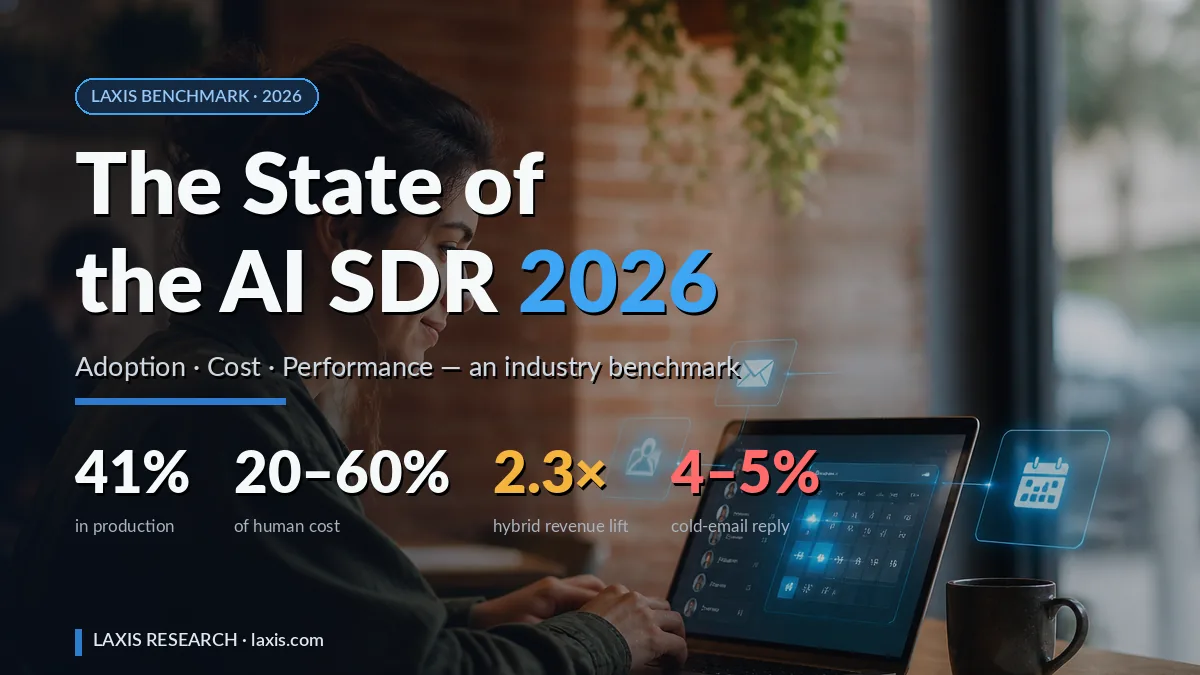
- The market data. State of AI SDR 2026 collects adoption and cost benchmarks with named sources.
Frequently asked questions
What's the difference between an AI SDR and a sales engagement platform?
A sales engagement platform (like Outreach or Salesloft) gives human SDRs tools to send sequences faster. An AI SDR replaces the human work — finding leads, writing personalized messages, sending sequences, handling replies, booking meetings — autonomously. The line has blurred in 2026 as engagement platforms add AI features and AI SDRs add manual controls, but the test is who's doing the work: a human with AI assistance, or an AI with human oversight.
Are AI SDRs actually replacing human SDR teams?
Mostly augmenting, not replacing. AI SDRs handle the top of the funnel — research, sequences, basic qualification — at scale. Complex objections, strategic conversations, and final qualification still benefit from human reps. The realistic 2026 model is a smaller team of senior SDRs supervising 2–3 AI agents each, with the AI doing the volume work and humans handling escalations.
What's the typical AI SDR pricing range in 2026?
It spans roughly $99/agent/month (Laxis) to $15,000+/month (11x enterprise), and the floor dropped during 2026 — Artisan cut self-serve entry to $250/month in May. Mid-range autonomous AI SDRs still cluster around $900–$3,000/month once you are running real volume (AiSDR Explore, Artisan's reported typical deals, Topo Growth). Watch the billing period as much as the sticker: AiSDR bills quarterly and 11x annually, so the cheque you write to start is three or twelve times the monthly number. Laxis remains the outlier at $99/agent/month, billed monthly, for an end-to-end multi-channel agent.
Which AI SDR has the best phone calling?
Laxis handles outbound and inbound AI phone calling at a non-enterprise price point ($300/1,000 minutes), and bundles it with the other four channels rather than selling it as an add-on. 11x's Julian handles inbound voice but is reportedly weak on outbound and conversation depth, and pricing the voice add-on on top of Alice pushes a deployment past the point where the maths works. Artisan added a dialer with Ava 2.0 in May 2026, so it is no longer a no-phone tool — I have not tested its call quality. AiSDR and Topo still offer no AI phone calling at any tier.
Can AI SDRs really write emails that prospects respond to?
When properly tuned to your ICP, yes — the better tools (AiSDR, Laxis, Topo) achieve 1.5–4.9% reply rates on cold email, with multi-channel motions getting closer to 8–14%. The tools that fell flat in my pilot — and in G2 reviews of the same period, pre-Ava-2.0 Artisan and 11x at scale — defaulted to surface-level personalization that prospects pattern-match as automated. Quality of inputs (ICP definition, signal triggers, knowledge base) matters as much as the agent itself.
Is it worth piloting more than one AI SDR at the same time?
Often yes, especially for mid-market teams. The pattern that works: pick one specialist tool (e.g., AiSDR for email or Topo for signals) and one end-to-end tool (Laxis), run them in parallel for 60–90 days against different segments, and compare reply rate, meeting volume, and CAC. Most teams converge on the end-to-end tool for the broad motion and use specialists for specific high-value segments.
Try the editor's pick: Multi-channel AI SDR + AI Phone Agent + bundled meeting assistant — from $99/agent/month, no annual contract. See Laxis AI SDR.