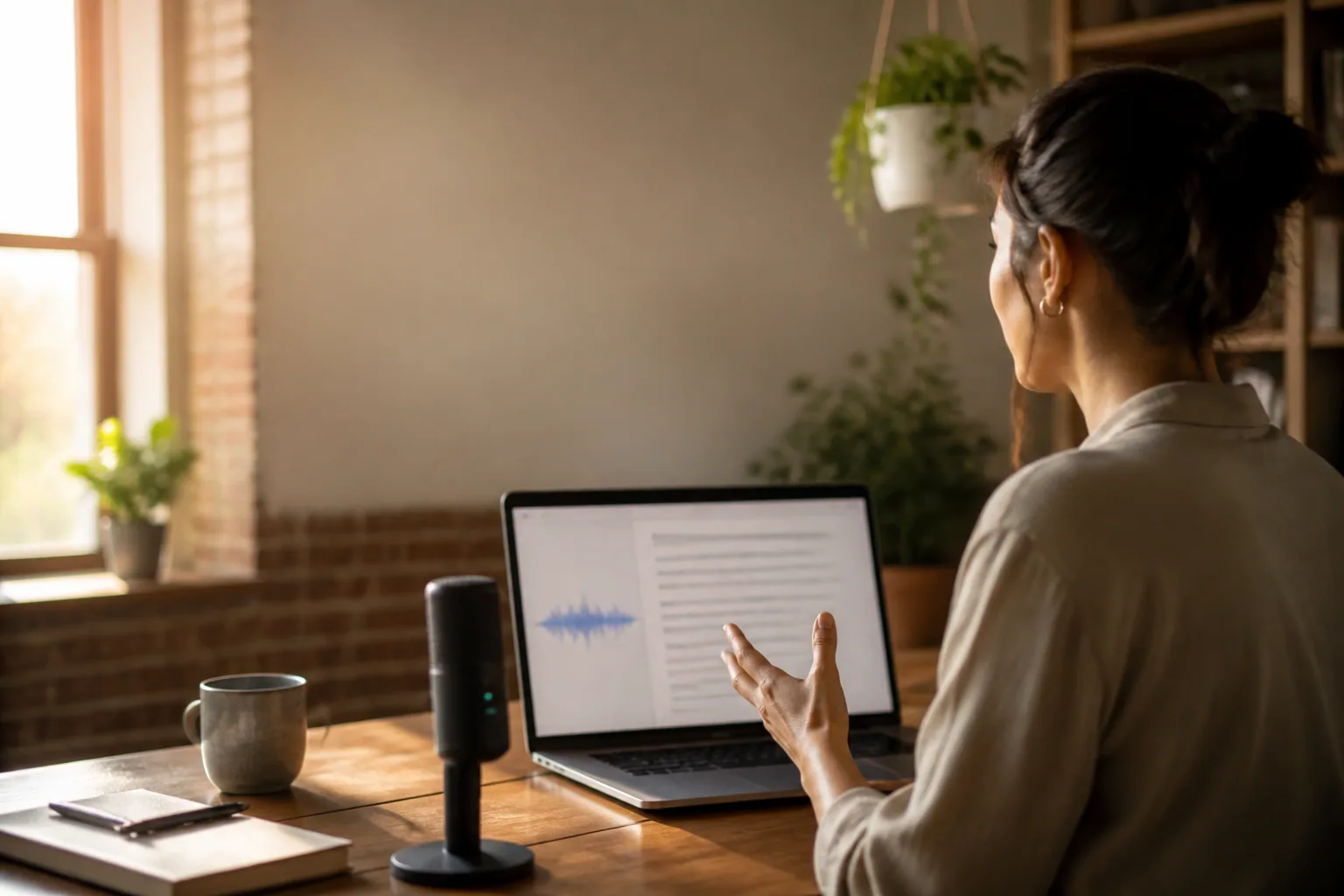
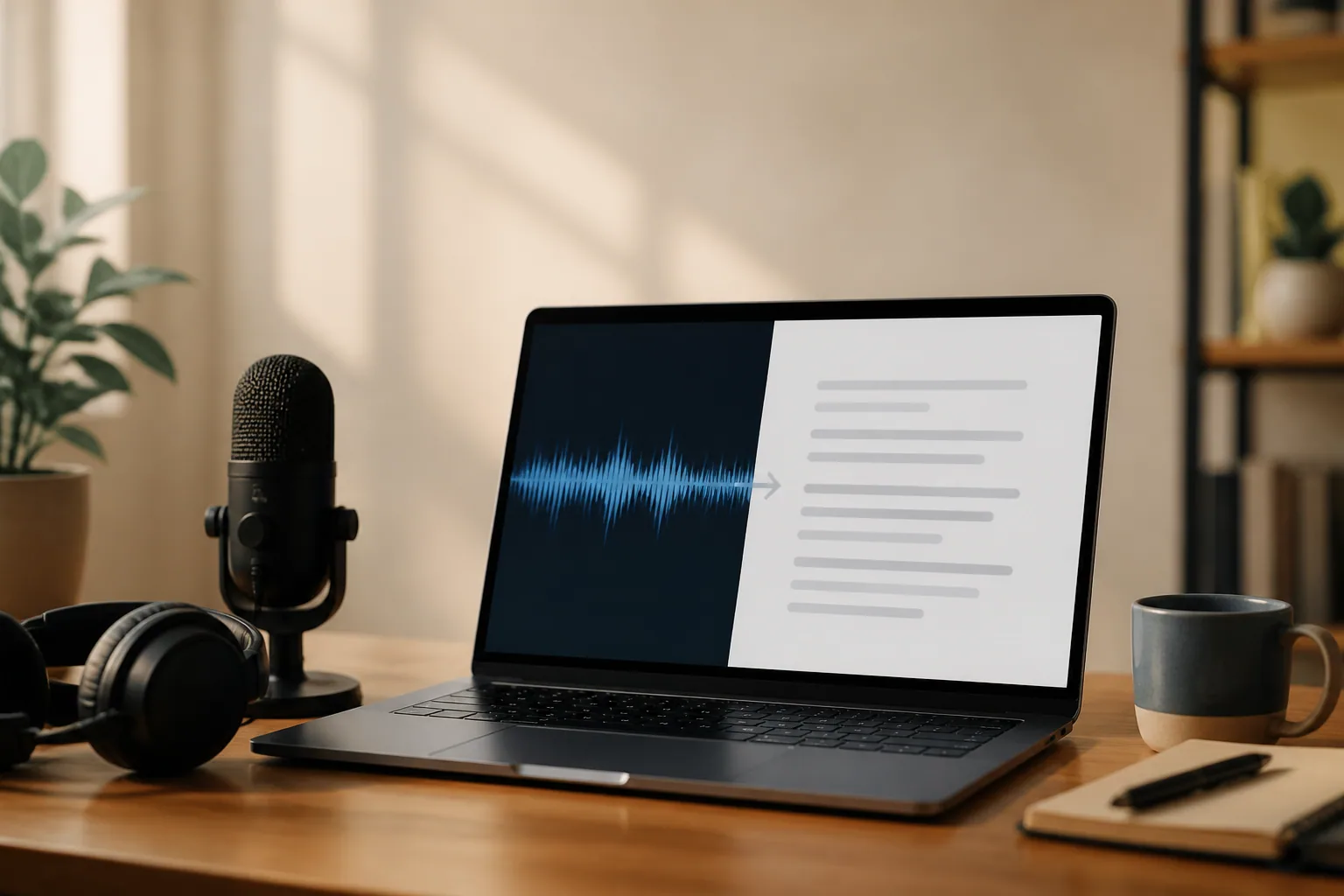
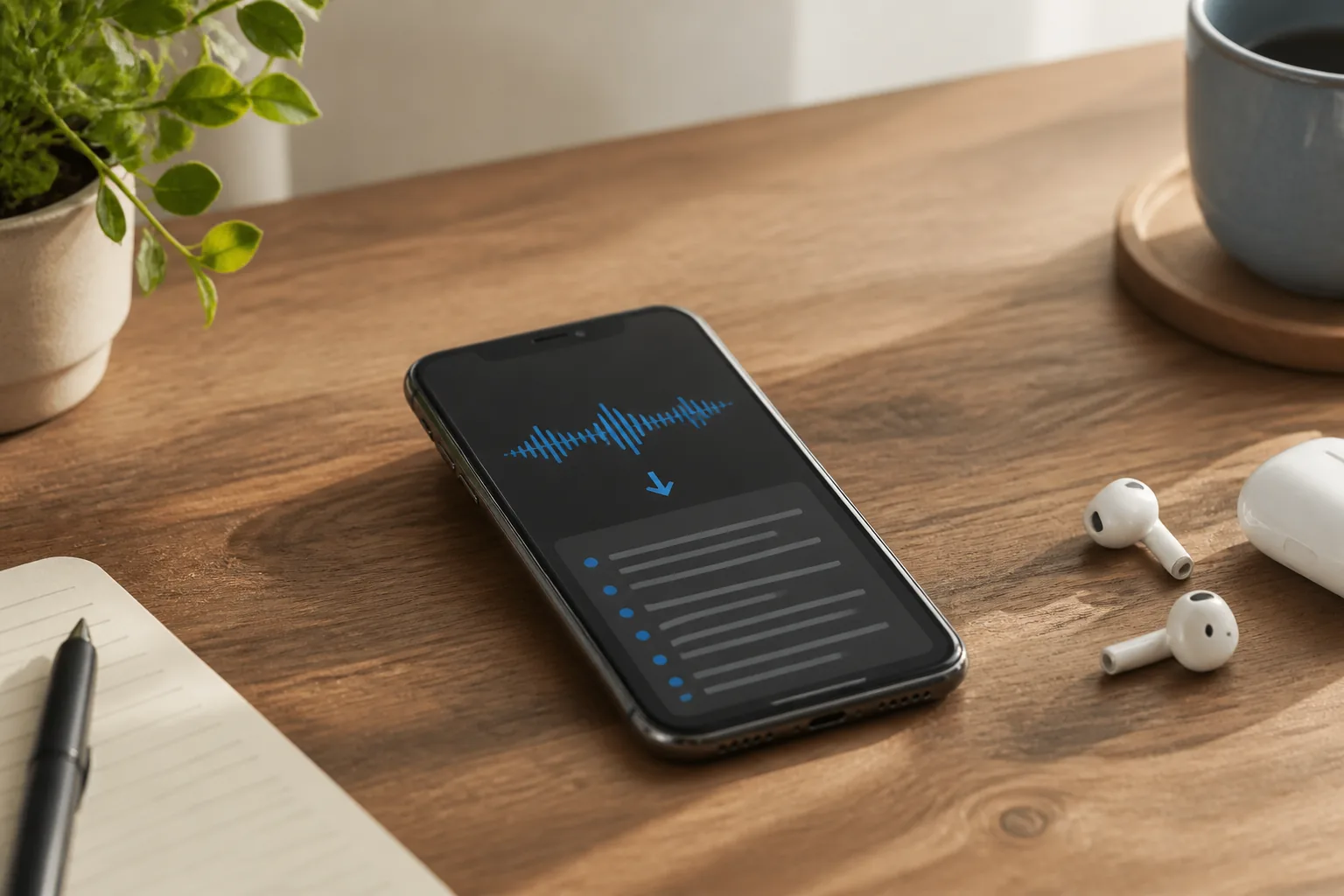
What Is Transcription? How It Works and Costs
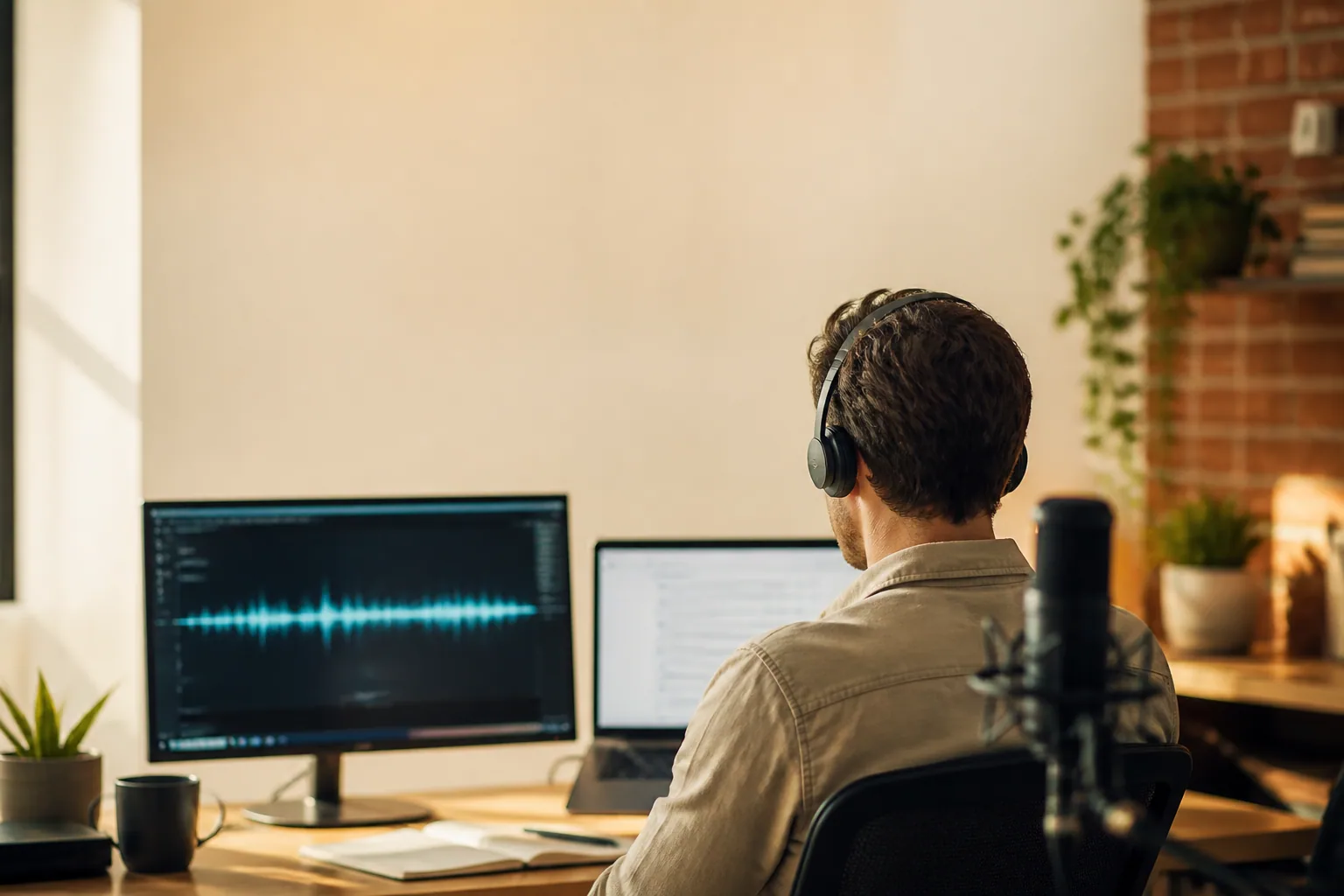
Play any recording of three people talking over each other and try to write down exactly what they said. Ten minutes of audio will cost you most of an hour, and you'll still be arguing with yourself over whether the second speaker said "can't" or "can." That gap — between hearing speech and pinning it to a page — is the entire discipline.
Quick disambiguation first, because this word does double duty. In biology, transcription is the step where a cell copies a stretch of DNA into RNA — a different topic, and not this page. Everything below is about the other meaning: converting recorded human speech into written text.
Transcription is an activity, not an artifact
Transcription is the work of listening to speech and rendering it as text in the same language: an input, a method (person, model, or both), an output. Confusion creeps in because English uses one root for the job and for what the job produces. The finished document is a transcript, and its layout, styles, and differences from captions are a separate topic — we've covered what a finished transcript looks like in its own guide. This page is about the doing.
Two neighbours are worth ruling out. Translation changes the language and keeps the medium; transcription changes the medium and keeps the language. Subtitling a foreign film needs both, in that order. And dictation is composing text by speaking deliberately — you're the author, talking at a device. Transcription deals with speech that was never meant to become a document: an argument in a meeting, a witness answering a question, three people on a bad conference line. If dictation is what you actually want, the best AI dictation apps is a more useful list.
That difference in intent is why transcription is hard in ways dictation isn't. Nobody enunciates for the record. People interrupt, trail off, pick the wrong word and fix it three words later, and say proper nouns no model has met.
Two ways it gets done, and a third that quietly won
Manual transcription is a person with headphones, a text editor, and usually a foot pedal for rewinding without taking hands off the keyboard. Play a few seconds, type, back up, verify. Slow playback for the hard passages, look up the drug name, flag what's unintelligible, then proofread against the audio again. Unglamorous, skilled work, and the price reflects real labour rather than a markup — an hour of audio is emphatically not an hour of work.
Automatic transcription hands the same job to an automatic speech recognition (ASR) system. Upload the file or stream the mic; text comes back in seconds. It never tires, never charges extra for a difficult accent, and costs an order of magnitude less. It also has no idea when it's wrong — the crux of everything below.
The hybrid — machine first pass, human correction — is what most professional services run in 2026, even the ones marketing themselves as human transcription. The economics are obvious: the model does the mechanical 95%, the person spends their time on the 5% that needs judgment. The trade calls this post-editing; our guide to transcribing audio to text walks through the workflow.
What actually happens inside an ASR system
You don't need the mathematics, but a rough model of the pipeline explains almost every weird failure you'll see.
1. Capture and clean the signal
Audio is resampled, converted to mono, and often run through noise suppression and voice activity detection to find where speech actually is. Garbage here is unrecoverable — no model can decode a voice that never made it into the file cleanly.
2. Turn sound into a picture
A raw waveform is a bad input for a neural network. The system slices audio into overlapping 20–30 millisecond frames and computes energy at each frequency band, producing a spectrogram — a heat map of frequency over time. At this point speech recognition is closer to image recognition than to anything linguistic.
3. Decode it into words
The spectrogram goes into a large neural network, nearly always transformer-based, trained on enormous quantities of paired audio and text. Older systems chained an acoustic model guessing phonemes, a pronunciation dictionary mapping those to words, and a language model scoring plausible sequences. End-to-end systems collapse all of it into one model emitting text tokens directly — which is why they generalize better, and why they occasionally hallucinate a fluent sentence nobody said.
4. Make it readable
Raw output is a lowercase string with no punctuation. Post-processing restores capitalization and punctuation, converts "fourteen ninety two" into "1492" (inverse text normalization), strips disfluencies if asked, and applies your custom vocabulary — the most underrated setting in any transcription tool.
5. Work out who was talking
Speaker labelling — diarization — is a separate system, not part of word decoding. It turns short segments into voice embeddings, clusters them, and assigns each cluster an ID. That's why words are often right while labels are wrong: two similar voices land in one cluster, or a label flips when someone moves closer to the mic.
Tip: give diarization a fighting chance. If your platform can record each participant to a separate audio track, turn that on — per-speaker channels remove the clustering problem entirely. Failing that, have everyone say their name once at the top of the call. Eight seconds, and the labels get far easier to fix.
The accuracy numbers, and what quietly wrecks them
The industry measures accuracy with word error rate: substitutions plus deletions plus insertions, over the words in the reference. A 5% WER means 95% word accuracy — one word in twenty wrong, missing, or invented.
Where things honestly stand: on clean, well-recorded audio the best systems land in the 95–98% word accuracy band, and Whisper has been benchmarked around 97.9%. On standard read-speech test sets, frontier cloud engines post 2–5% WER, and results below 2% approach human parity under controlled conditions. The open-model race has compressed hard: Cohere's Transcribe topped the Hugging Face Open ASR Leaderboard at 5.42% average WER in March 2026, and IBM's Granite Speech 4.1 2B edged it at 5.33% five weeks later.
Those are laboratory conditions. Here's what moves them, roughly in order of damage done:
- Overlapping speech. The worst offender by a distance. When two people talk at once, most systems produce a mangled blend or silently drop one. Meetings are full of it; benchmark sets aren't.
- Distance and room acoustics. A laptop mic across a conference table picks up reverb and HVAC hum. Reverberation smears the spectrogram, and the model decodes the smear.
- Accents and dialects. Accuracy varies by speaker, and the gap tracks how much of that accent appeared in training data. Industry-wide, not vendor-specific — every tool on the market, ours included, degrades on strongly accented speech and heavy crosstalk.
- Specialist vocabulary and proper nouns. Drug names, tickers, legal citations, your CEO's surname. A model that has never seen a word can't output it, and substitutes the nearest thing it does know.
- Code-switching and phone audio. Speakers moving between languages mid-sentence break systems that committed to one language up front, and narrowband telephony throws away the high frequencies that separate similar consonants — "S" and "F" are hard to tell apart at 8 kHz.
One caveat about the metric: WER treats every error identically. Dropping "the" scores the same as dropping "not," which is why researchers keep pushing semantic error measures. A 96% transcript with the wrong number in the pricing discussion is worse than a 92% one that got the figures right.
Tip: the microphone beats the software. Moving from a laptop's built-in mic to a $60 USB microphone or a decent headset improves accuracy more than switching vendors will. Close-miking removes room reverb, raises signal-to-noise, and keeps consonants intact — all before the model starts.
Cost and turnaround: the tradeoff in actual numbers
Figures rather than adjectives. Professional human transcription runs roughly $1.00 to $3.00 per audio minute — about $60 to $180 per hour of recording — with specialist legal work climbing toward $5.00 a minute. Difficult audio isn't free: background noise, several speakers, or heavy accents commonly add a 25–50% surcharge. Standard turnaround runs 12 hours to three business days.
Automated services advertise between $0.10 and $0.50 per minute metered, and turnaround is effectively instant. Subscription products bundle minutes instead, which changes the maths at volume. Laxis, for instance, includes 300 transcription minutes a month free, then flat per-seat pricing at $15.99 for Premium and $29.99 for Business — at 20 hours of calls a month, per-seat works out very differently from per-minute.
| Approach | Typical cost | Turnaround | Accuracy on clean audio | Accuracy on hard audio | Best for |
|---|---|---|---|---|---|
| Human transcription | $1.00–$3.00 per audio minute (~$5.00 for legal) | 12 hours – 3 business days; rush extra | 99%+ achievable, verified against audio | Degrades gracefully — a person flags what's unclear | Court records, regulated documentation |
| AI transcription | $0.10–$0.50 per minute, or bundled | Real time to minutes | ~95–98% word accuracy | Falls off sharply and silently — no signal it's wrong | Meetings, sales calls, search and recall |
| Hybrid (AI draft + human edit) | Below full human rates; varies by edit depth | Hours to a day or two | Approaches human accuracy | Good — the human catches what the model missed | Research interviews, published content, quotable material |
When you still need a person in the loop
The honest test isn't "how good is the AI." It's "what happens if one word is wrong?" Where the answer is "nothing much, I'll spot it," automation wins outright. Where it involves a judge, a regulator, a patient, or a published quote, put a human on it.
Concretely: court proceedings, where the transcript is evidence and often needs certification; regulated medical documentation, where an error enters a permanent record; anything going to print with a named source attached; and audio that's genuinely bad, because a person will tell you a passage is unintelligible while a model produces confident nonsense.
For most of that list the smart move isn't full manual transcription. It's the hybrid: run the machine pass, then pay someone to verify it against the audio.
Transcription as a job, in the middle of all this
People still do this for a living, and the work has changed more than the headcount. The classic path was general transcription for media and business, with legal and medical as specializations requiring extra training and certification. US pay sits around $20 to $29 an hour in 2026 depending on source and specialty — Indeed puts the average near $26.49, PayScale reports about $21.75 for transcribers, and Glassdoor has legal transcriptionists close to $29.
What changed is where the hours go. Very little of the job is typing a blank page now; most of it is correcting a machine draft, which sounds like a demotion and mostly isn't. Value concentrated in the parts models handle worst: proper nouns, speaker attribution, domain vocabulary, formatting standards, and the certified statement of accuracy that makes a document admissible. Someone who only types fast competes with software that types faster.
How to choose an approach
Five questions:
- Stakes of an error? Legal, medical, or published — human or hybrid. Internal meetings and research — automated.
- How good is the audio, honestly? One person on a headset is a different problem from six around a laptop. Be pessimistic; it predicts results better than anything else.
- How much volume? A handful of files a year favours pay-per-minute; ten hours of meetings a week favours bundled minutes, and break-even arrives sooner than people expect.
- When do you need it? If the answer is "before the follow-up email goes out," a two-day turnaround is out however accurate it is.
- Where can the audio go? Cloud processing is more capable, and it means your recording leaves your machine. Most tools worth using are cloud-based, Laxis included, so read the retention policy and check whether the vendor trains on your data.
For recurring business meetings the calculation usually resolves toward automated capture with a good microphone and a tool that does something with the output instead of handing you a wall of text — summaries, action items, CRM sync. That's the category our comparison of the best AI note-takers of 2026 covers, and it's a different decision from picking a transcription service.
Turn every call into text you can actually use
Laxis records, transcribes, and summarizes Zoom, Google Meet, and Microsoft Teams across 100+ languages, extracts action items, and syncs to HubSpot and Salesforce. Free plan includes 300 transcription minutes a month.
The bottom line
The genuinely interesting shift isn't that machines got good at this. It's what cheap transcription did to the decision of what to record at all. When an hour of audio cost $120 to convert, you transcribed the deposition and the board meeting and nothing else. At a few cents a minute the constraint moved from cost to attention. Everything gets transcribed now, so the hard problem isn't producing the text; it's deciding which fraction any human will ever read. Knowing which twelve sentences out of nine thousand mattered is where the work went.
Frequently asked questions
What is transcription?
Transcription is the process of converting recorded speech into written text. A trained person can do it by listening and typing, or an automatic speech recognition model can decode the audio signal into words. Most professional work in 2026 combines both: a machine drafts, a human corrects.
How does automatic transcription work?
Automatic transcription converts the audio waveform into a spectrogram, feeds that into a neural network trained on huge amounts of paired speech and text, and decodes the most likely word sequence. Separate stages then restore punctuation and capitalization, format numbers and dates, and attempt to label who spoke each segment.
How accurate is AI transcription?
On clean, single-speaker audio, leading systems reach roughly 95 to 98 percent word accuracy, and OpenAI's Whisper has been benchmarked at about 97.9 percent. Real conditions are harsher. Strong accents, overlapping speech, distance from the microphone, background noise, and specialist vocabulary all push accuracy down, sometimes sharply.
How much does transcription cost?
Professional human transcription generally runs about $1.00 to $3.00 per audio minute, or roughly $60 to $180 per audio hour, with specialist legal work reaching around $5.00 a minute. Automated services typically advertise $0.10 to $0.50 per minute, and subscription tools often bundle a monthly minute allowance instead of metering.
Is transcription the same as translation?
No. Transcription keeps the same language and changes the medium, turning spoken words into written ones. Translation keeps the medium and changes the language. Video subtitling often needs both steps in sequence: transcribe the original audio first, then translate the resulting text into the target language.
How long does transcription take?
Automatic transcription is effectively immediate, returning text in real time or within minutes of upload. Human services usually quote 12 hours to 3 business days for standard turnaround, with same-day rush available at a premium. Hybrid workflows, where a person edits a machine draft, typically land somewhere in between.
Is transcriptionist still a real job?
Yes, though the work has shifted from typing from scratch to reviewing and correcting machine drafts. US transcriptionists generally earn somewhere around $20 to $29 an hour in 2026 depending on specialty, with legal and medical work at the top. Certification and domain vocabulary matter more now than raw typing speed.